Showing posts with label 2005. Show all posts

Sunday, February 27, 2022

Topps Cards That Should Have Been: 2005 Padres


 Now that the Padres are competitive again, it's fun to go back to the mid-2000s teams to find a time when they were also competitive, but arguably with a lot less than they have now. Like, in 2005, the Padres finished only 2 games over .500, being the only team in the NL West over .500 as well. Three NL East teams that did not make the playoffs had a better record- the Phillies, Marlins and Mets. Because this was the pre-Manfred era of baseball, the division leader that squeaked into the playoffs didn't end up winning the whole thing. The Friars got clobbered by the Cardinals in 3 games, it wasn't gonna be close. 

There were some interesting things about this team as far as Topps non-documentation is concerned. Perhaps the biggest 'star' in this pack to discuss is Chan Ho Park, dealt from the Rangers at the deadline for some rotation depth. In 10 games, Park went 4-3 with a 5.91 ERA with San Diego, and didn't make the postseason roster. Fortunately the Korean fireballer would have a better season with the Padres in 2006, and make the transition to his late-decade relief work with Philadelphia. 

Ironically, before dealing with the Rangers for Park, the Rangers released Pedro Astacio, the longtime NL West starter, and the Padres had almost no choice but to bring him back into the division against his old teams in Denver and LA. Surprisingly, Astacio was solid in 12 games with the Friars, posting a 3.17 ERA and 33 Ks, along with a 4-2 record. He'd even get a postseason start out of it, despite said start being a loss in Game 2. 
Chris Hammond, at the very least, has an interesting MLB story. Original Florida Marlin, played every year from 93 to 98 for the Marlins except, of course, for the year they win it all. Starts a ton of games, gets shifted to the bullpen as the real arms come up. Bops around the minors for a few years, reinvents himself as a middle reliever in the 2000s and becomes an underrated unsung hero type. Coming off of three stellar seasons with Atlanta, New York and Oakland, he comes to San Diego. In 55 games he posts a 3.84 ERA, his highest since returning to the majors [he had a 0.95 with the Braves], and has 34 Ks. He only pitches one more season after 2005, but he was still in strong shape.

Tim Redding had been a decent starting option in Houston during the early 2000s. The Astros needed catching help, so they traded him for Humberto Quintero prior to the 2005 season. Redding disappointed in 9 games for the Padres, going 0-5 with a 9.10 ERA and 30 earned runs. He'd later be dealt to the Yankees in exchange for...

...reliever extraordinaire Paul Quantrill! People tend to forget this, but for four straight seasons, Canadian legend Paul Quantrill led the league in appearances, and from 2001 until 2004 had a combined 6.5 WAR, from stints with Toronto, Los Angeles and, of course, the Yankees. His 2005 Yanks numbers were comparatively a disappointment, so he was dealt to the Padres. While Redding only had 1 disastrous start for the Yanks, Quantrill was decent enough in San Diego, with a 3.41 ERA in 22 games. He was ultimately released at the end of August and picked up by the Marlins, with whom I could not find any images of Quantrill from. And after that he retired and helped his kid become a major leaguer himself.

I've talked about fringe icon Robert Fick on here before, so, to recap, after going from farmhand to all-star with the Tigers, Fick struggled to recapture the magic in stints with Atlanta and Tampa. So in 2004 he's dealt to the Padres, and in 2005 he actually becomes a halfway decent bench bat in San Diego. In 93 games he hits .265 with 30 RBIs and 61 hits, even if he's basically a replacement level player at this stage. He eventually becomes a similar bench bat with the Nats to finish out his career.

Eventually I'll go over the similar energy in the Padres' 2006 playoff run. 

Monday, February 21, 2022

Topps Cards That Should Have Been: 2005 Nationals


In 2005, the Montreal Expos moved to Washington and became the Nationals, and were tasked with making a failing team work in a new market. Topps was also tasked with marketing this new team in their sets, and giving an accurate representation of the team while the season was still going on. They had an insert set denoting the team's inaugural lineup, they had plenty of Nats in the base set...but it wasn't enough, was it?
Here, for the record, is all the Nats Topps were able to provide: Termel Sledge, Brian Schneider, Tomo Ohka, Endy Chavez, Cristian Guzman, Tony Armas Jr., Sunny Kim, Nick Johnson, Chad Cordero, Esteban Loaiza, Vinny Castilla, Jose Guillen, Jose Vidro, Brad Wilkerson, Livan Hernandez, Marlon Byrd and Frank Diaz. 

Then, after the season, Topps apologized for their underrepresentation by producing a special retail set of the Nationals in mostly posed shots. This included some of the deeper roster cuts, like John Patterson, Gary Bennett, Ryan Church, Jared Sandberg, Brendan Harris, Zach Day, Luis Ayala, Jeffrey Hammonds, Jamey Carroll and Brandon Watson. And you'd think that'd cover the rest of the bases.

There are still cards I need to create for this. So while Topps tried to do an exhaustive job...there are still holes.

For instance, former Rockies all-star Preston Wilson, who was beginning to fall on hard career times, was traded to the Nats midseason. They had time to put him in Update...they didn't. Wilson was actually a nice piece of the second half for the Nats; in 68 games, he hit .261 with 43 RBIs and 10 home runs. Along with his Cards numbers in 2006, these were some of the last great numbers of his career.

The Nationals went through a ton of extra infielders in their inaugural season. First they had Junior Spivey, who did well with Milwaukee and Arizona. Spivey was another midseason trade, cause the Brewers weren't happy with his stuff. In 28 games with Washington, Spivey was a decent defensive option but hit .221. He'd never make the majors again after this season.

They also tried Deivi Cruz after a midseason trade, after some decent numbers with the Giants. Cruz, also for HIS last career numbers in the majors, hit .255 with 1 RBI in 20 games. Cruz was mostly used as a defensive substitution, and even his defensive numbers were failing by this point. 

And the Nats also went for former Expo Wil Cordero, who did very well for them in the early 90s as well as just a year or so earlier. Cordero had 29 games as a National and hit .118 with only 6 hits. After the cut, like the theme, he wouldn't make the majors again. 

CARLOS BAERGA WAS STILL PLAYING IN 2005, PEOPLE. After a couple years with the Diamondbacks, Baerga was clearly a bench guy, far from his status as an all-star second baseman with Cleveland. In 2005 he was a bench backup with Washington, and...look, these are pretty decent numbers. In 93 games, he hit .253 with 19 RBIs, but his fielding clearly wasn't to 1993 levels. Baerga would retire after the season. 

Even stranger, former Dodgers and Yankees reliever Antonio Osuna suited up for the Nats for four games. He'd done some strong, consistent stuff for years, but by 2005, he was running out of juice. In those 4 games he'd leave with a 42.43 ERA, with 11 earned runs in 2.1 innings. Oof. Like everyone in this post except Preston Wilson, the 2005 Nationals would finish off Osuna's career. 

I guarantee the next one's gonna be happier. 

Monday, January 24, 2022

Topps Cards That Should Have Been: 2022 Hall of Fame Class Edition


Like last year, we celebrate the impending Baseball Hall of Fame inductions with a run through the uniforms that should have been depicted on cards, regardless of how brief or perfunctory they were.

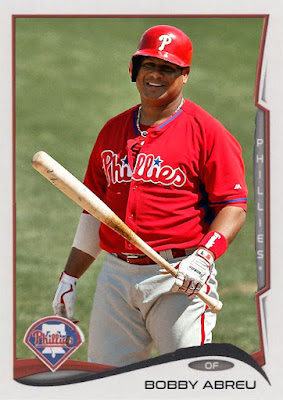
I should have included this in last year's bunch, but in 2014, Bobby Abreu signed a minor league deal with the team that made him a household name, the Philadelphia Phillies. The majority of his supremely underrated Hall of Fame case came from his Phils days, and having him back, even at the end of his career, was a cool move. Though Abreu spent the Spring with the Phils in Clearwater, he did not make the team, and would eventually sign a deal with the Mets, which would go surprisingly better for him rounding out his career. Still...wouldn't it have been awesome to see one more Phils Abreu card? It would have felt the same as 2012 Topps' Jim Thome Phils card.

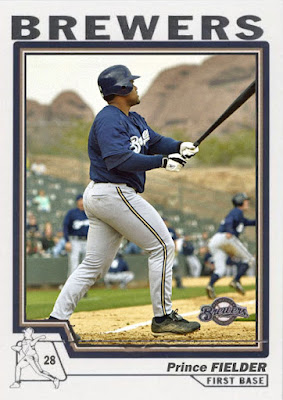
Zipping us back to the top with the new additions to the ballot, most of whom may not make more than 5% admittedly, while I already made a 2005 Topps card of Prince Fielder back in November, I did not make one to commemorate his 2004 Spring Training sting. While Fielder was still a year or so away, he did have some solid numbers out of camp for the Brewers, but he was still blocked behind Lyle Overbay for another year. He'd eventually own first base and become a fixture to round out the decade.

Justin Morneau's 2004 issue would have been more crucial, as Morneau would be an important part of the Twins' infield that year, playing 74 games, hitting .271 with 19 homers in that time. Unfortunately, Morneau would only get cards from Topps in Heritage and Total, skipping flagship altogether. A bit of an odd exclusion, given his appearances in 2003 and 2005 sets. Nevertheless, from 2005 on, Morneau would be a strong, consistent piece of the mid-2000s Twins teams, culminating in a 2006 MVP win that I'm still kinda bitter about.
While Jonathan Papelbon's rookie card was in 2006 Topps, he was used out of the pen during 17 games in 2005, and did fairly well, with a 2.65 ERA and 34 Ks. Of course, the very next season Papelbon would get the ninth inning and become a hero in Boston. Before...y'know...pissing off Philly and Washington.
In 2016, Joe Nathan was coming off a disappointing campaign in Detroit, and after amassing all star nominations as a Twin and Ranger, was coming down big time. Midway through the season he signed a deal with the Cubs, as they embarked on their championship campaign. He only pitched in 3 games for Chicago, but struck out 4 and gave up no runs. The Cubs did release Nathan shortly afterwards, and he wasn't finished. 
So he decided to return to San Francisco, where he'd spent his early career. As a Giant, in September, Nathan pitched in 7 games, struck out 5 out of 18 batters, and continued his scoreless streak. He ended the season with a 0.00 ERA, which was strong enough numbers to go out on. While I doubt Nathan will get into the HOF, he was still an excellent closer and relief asset, and still had some stuff left in the tank even at the end.
And finally, we come to Jimmy Rollins as a White Sox. After his Dodgers deal went disappointingly, Rollins' stock declined, and could only muster a minor league deal with the tanking ChiSox. The best you can say for J-Rol here is that he was an impressive prelude to Tim Anderson, hitting .221 with 33 hits and 8 RBIs in 41 games. Once Anderson was called up, there was really no reason for Rollins to be on the roster, and he was quietly released, tying up his 17 year career there. Of all the newbies on the ballot, I have the highest of hopes that Rollins can someday make it to the Hall of Fame, even as unlikely as that seems. He was always a favorite, and always seemed to be an elite shortstop.

Tomorrow...I am actually gonna do an Unofficial HOF Ballot post. It's gonna be...something, alright.

Tuesday, November 30, 2021

Topps Cards That Should Have Been: 2005 Yankees


2005 was the last time I saw a regular season game at the old Yankee Stadium. Esteban Loaiza was pitching. It was really damned hot. I think the Yanks won.

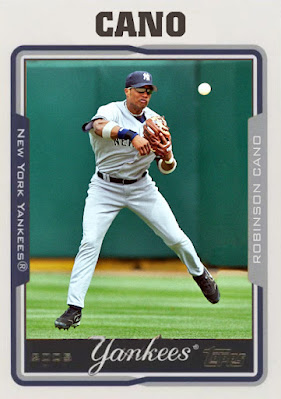
This was another Torre team that tried to recreate the 90s success and couldn't, though we certainly tried. More importantly, after the Tony Womack signing was kind of a flop, 2005 was the first year of Robinson Cano's ascent to 2nd. And while the PED charges have tainted the once extraordinary career for the hard-hitting 2nd baseman, you have to admit that his rookie year was still pretty refreshing. 22 years old, hitting .297 with 62 RBIs and 14 homers in an 132 game rookie season, and finishing second in the ROY voting to Huston Street.

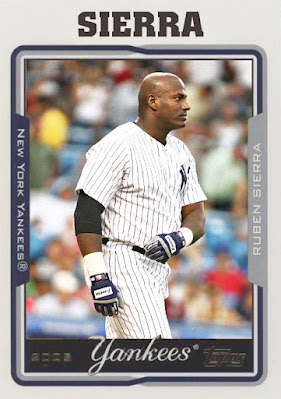
More from Ruben Sierra. 2005 was Sierra's last year of bench-DH work in New York. In 61 games, the 39-year old former Rangers phenom hit .229 with 29 RBIs and only 4 homers. With Giambi and Tino switching off at DH, Sierra mostly was a bench bat, and a kinda shoddy one at that. Minnesota would be next. 

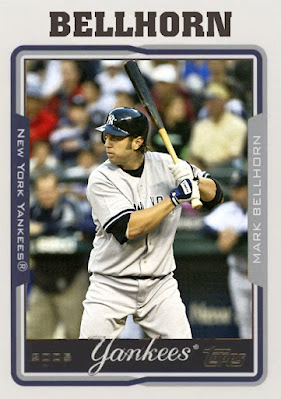
How rare is this? A year after being a crucial member of the Red Sox team that knocked off the Yankees in Game 7 of the ALCS and won the Series, Mark Bellhorn was cut by the Sox in August and picked up by the rivals. A prelude to Johnny Damon, I suppose, but with shakier results. Bellhorn's stuff had dissolved since his Boston heyday, and he only hit .118 with 2 RBIs in 9 games for the Yankees before getting cut again. 
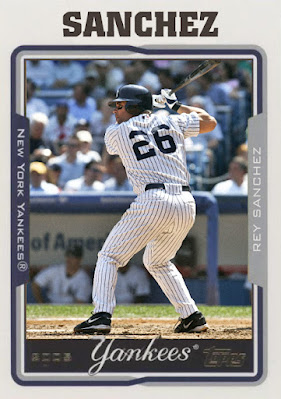
And former Cubs infielder and frequent MLB traveler over the late-90s and early 2000s Rey Sanchez gave his last MLB numbers as a member of this Yankee team. After a strong defensive season in Tampa, Sanchez handed in negative defensive totals, and hit a decent .279 over 23 games. Bit of a whimper to go out on.

Tomorrow Uncustomed Heroes begins!!

Saturday, November 20, 2021

Topps Cards That Should Have Been: 2005 Pirates

 While in the midst of their 'so godawful it's not even funny' phase of the mid-2000s, the Pittsburgh Pirates were able to accumulate some bizarre talent, mostly because their team would be consistently be a base for 'look, no one's watching, let's give this guy a shot' mentality players. 

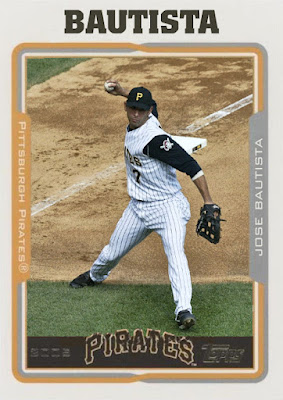
The most important one for the purpose of this post is Jose Bautista. 2005 was a more stable year for Joey Bats- instead of playing for four teams in one season, he just had the one, the Pirates. This was a year before the Pirates would figure out exactly what to do with Bautista, as they still had Freddy Sanchez and Ty Wigginton as primary 3rd base options. So in 11 games in 2005, Bautista only hit .143 with 4 hits and, shockingly, no home runs. He'd do much better in the years to come.

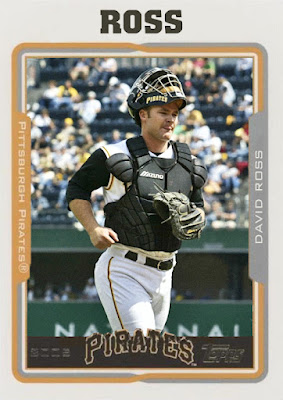
As for backup catchers, the Pirates went through a couple over the course of the season. The primary options were Humberto Cota and Ryan Doumit, and Ronny Paulino would be brought up later as a future option. In between that, the Pirates tried David Ross, pre-Grandpa Rossy era of backup catching. Ross hit .222 in 28 games, but was mostly relied upon as a defensive upgrade. He'd find a more stable home shortly as a member of the Reds, and would later become Jon Lester's personal catcher in Boston and Chicago.

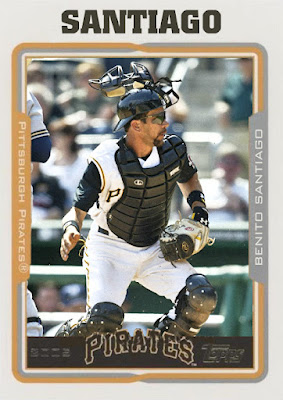
Stranger still, the Pirates began 2005 with the top-string option at catcher being Benito Santiago, who was 40 years old and coming off a weaker year with Kansas City after some, hmm, SURPRISINGLY STRONG SEASONS IN SAN FRANCISCO WHILE BARRY BONDS WAS THERE. Santiago was the team's opening day catcher, and played 6 games for the Bucs, hitting .261 with 6 hits, but struggling defensively. After being cut, he'd try once again with the Mets in 2005 before hanging it up.

Tomorrow, I'll unveil some 2014 Rangers that Topps should have done something with.

Saturday, November 13, 2021

Topps Cards That Should Have Been: 2005 Mariners

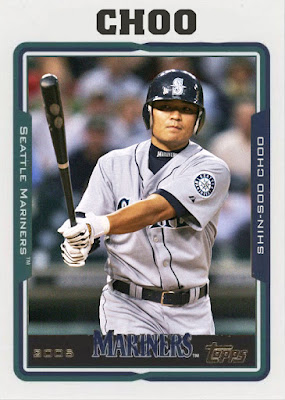
Not much publicity was made about Shin-Soo Choo when he was with the Mariners. They brought him up, gave him some opportunities, then when there weren't any, shipped him to Cleveland. As odd as it was for the legendary Indians, Reds and Rangers outfield bat to be a Mariner for a bit, it's one that I wish popped up on cards more often. 

But, 10 of the 14 games he'd play in Seattle would come in 2005, a semi-transitional year for the oft-middling club. He wouldn't have the greatest 10 games either, hitting .096 with only 1 hit and 1 RBI in this period, before being sent back down again. Thankfully, his best contact numbers would come after 2009. I hope he's still doing alright in the Korean leagues, and even if a return to the US would be unlikely, it'd be cool to see him back here.
 

On slightly more normal Seattle shores, J.J. Putz had another solid bullpen year in 2005, and because he wasn't closing, Topps shrugged its shoulders. Putz appeared in 64 games and had a 3.60 ERA, with his best season to date, and putting in a major audition to take the ninth after Eddie Guardado would vacate the position the following year. Putz would have a long career, in and out of the ninth.

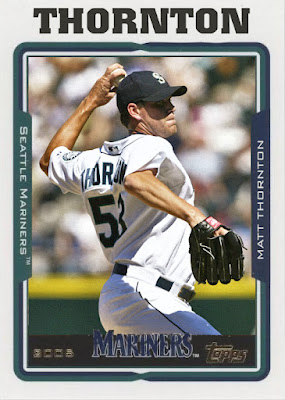
Another adept bullpen arm that didn't get a 2005 Topps card was Matt Thornton, a second year relief piece who, while bulging to a 5.21 ERA in 55 games, still showed consistency and availability, paving the way for several seasons of great relief work, culminating in some excellent seasons with the White Sox. 

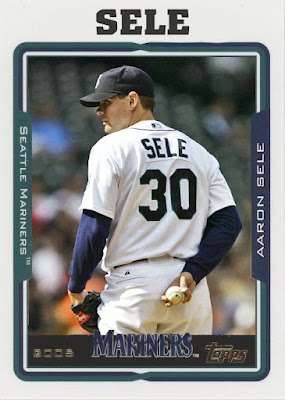
Onto some stranger cases. A lot of people forget about this, but after his lauded Mariners and Angels runs, former Red Sox prospect Aaron Sele continued to bop around for a little while longer, with diminishing uses. In 2005 he was still being used as a starter by his former team, the Mariners, who he linked back up with after the Angels deal lapsed. He did alright, with a 6-12 record and a 5.66 ERA in 21 games. He was eventually phased out of the rotation in favor of some young kid named Felix Hernandez, and would continue searching for playing time for 2 more seasons.

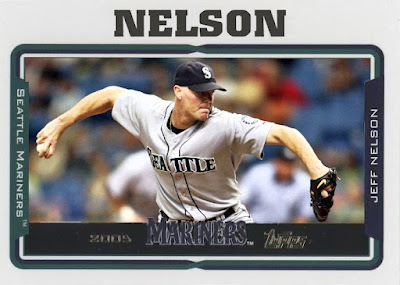
One of the single best relief pitchers that most baseball fans have never heard of is Jeff Nelson. Bold statement, I know. But his work with the Mariners and Yankees from the 1990s until 2003 is largely some of the most consistent relief work of that period. Nelson was around for all four Yankee WS rings, and is still regarded as New York legend. By 2005, he was coming off a rougher season with Arlington, and came back to Seattle, who'd always done him well. He responded with the last great season of his career, with a 3.93 ERA and 34 Ks in 49 games, a level of consistency that not only matched up with his younger peers, but was equally impressive for a 38 year old. He'd get some playing time in Chicago the following year before hanging them up.

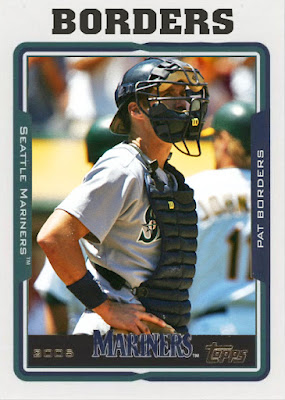
Pat Borders' story after leaving Toronto is strange. Guy was a huge piece for a WS-winning machine, a great catcher for a few years in the early 90s, and after that he...completely disappears. In the remaining 11 seasons of his career, he'd play for 8 teams, average about 40 games per season, get work mainly as a backup, and just sort of...be in the background of other great MLB stories. The one team that did enjoy bringing him back as an option in his late 30s was the Seattle Mariners, and in 2005, with injuries to multiple catchers, Borders got more playing time than he'd had in years at age 42, with 39 games, and a .197 average and 23 hits in that time, all while being an average catcher. For the last numbers of his career, they were relatively dignified, and Topps would even give him a Heritage release in 2006. Just not a flagship card.

Tomorrow, some Marlins that should have been in 2014 Topps, including some players that really should have appeared on a card in those uniforms.

Friday, November 12, 2021

Topps Cards That Should Have Been: 2005 Indians


 I think the modern relief pitcher has lost the art of being horrendously out of shape and still really good. The 2000s were a decade where Rod Beck, Todd Coffey, Todd Jones and Antonio Alfonseca were trusted relief pieces while also being big doughy guys. I think the doughiest relief guy we have now is Andrew Chafin, and he's in more shape than a lot of those 2000s guys. 

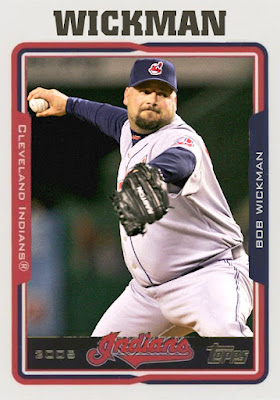
I think the patron saint of these was Bob Wickman. Bob Wickman played for 15 years, became a hit in midwestern cities like Cleveland and Milwaukee, and just got up there and got people out in the ninth. Though he had some nice seasons in the late 90s and early 2000s, the biggest statement might have been in 2005, when he led the league in saves with 45, made an All-Star team, and did so while only striking out 41. 

And yet...because Topps just LOOOOVES relievers, Wickman not only didn't get a Topps flagship card, he didn't even get an All-Star card. It was damn near shameful. Wickman would get an Indians card in 2006, but by that point the writing would be on the wall, and he'd be finishing the year in Atlanta. 

Let's look into two other crucial 2005 Indians that Topps also forgot...

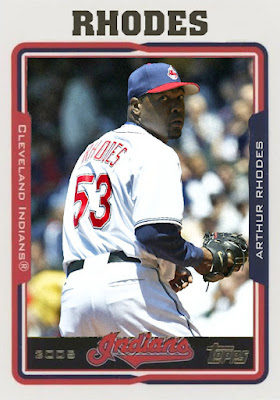
I always forget how dirty Topps did Arthur Rhodes before his renaissance in Cincinnati and Texas. After spending all of the 90s with Baltimore, Rhodes bopped around the AL for the early 2000s. He landed in Cleveland for the 2005 season and put in another strong campaign, with a 2.08 ERA in 47 appearances. A solid 1.0 WAR year for the career middle reliever. He'd go to Philly for 2006, with less starry results.

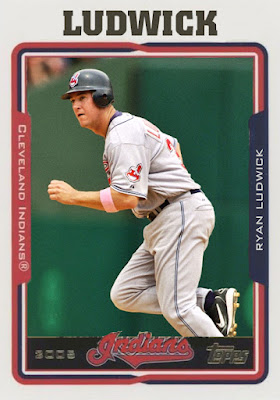
While everyone knows about Ryan Ludwick's career renaissance with the Cardinals, and how he turned that into a solid second career half in cities like San Diego and Cincinnati, people tend to forget that for the early 2000s, he was an A's farm product kicking around for far too long. First of all, he's a big piece of the Carlos Pena trade, so humorously depicted in Moneyball, then the Rangers trade him to Cleveland for Shane Spencer, and he spends his Indians tenure trying and failing to find starting time. 2005 would be the last of this tenure, as in 19 games he'd only hit .220, albeit with 4 homers. After a botched year in Detroit, he'd find his way to St. Louis and the rest would be history.

We're staying in 2005 for tomorrow's post, there are some cool Mariners to talk about from then.

Saturday, November 6, 2021

Topps Cards That Should Have Been: 2005 Brewers


I'm starting this post on Topps' omissions from the 2005 Brewers with a sensible one, cause they're only gonna get less sensible as we go.

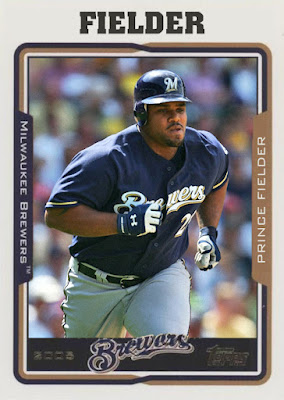
So. 2005 was the first season for Prince Fielder. He had a prospects card shared with another player in flagship, I gave him a full solo one because he deserved one. Despite only playing in 39 games, Fielder showed enough promise to carry the next stage of Brewers baseball, hitting .288 with 10 RBIs and 2 homers, admittedly less than I would have figured. 

Additionally, a very sensible pick for this series would be a 2005 Topps card of Derrick Turnbow, during the best season of his career. While Topps made up for this in 2006, not having one in '05 as he's notching 39 saves is kind of an odd move. In addition to the 39 saves, Turnbow also sported a 2.9 WAR, fifth highest on the whole team. Topps' bias against relievers really pisses me off sometimes.
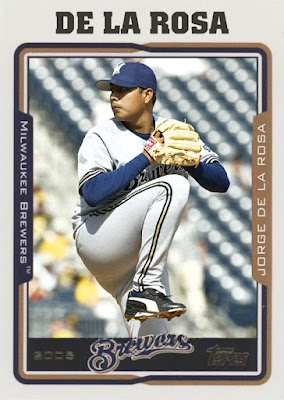
It would probably also be relatively sensible for this post to include a card of Jorge de la Rosa in his first full season. Despite Topps leaving him off, as a fairly straightforward relief pick, De la Rosa still appeared in 38 games, had a 4.46 ERA and 42 Ks, showing signs of future dominance with the Rockies. However, said move to Denver would be a team or so away, and here he was just a relief piece rather than a crafty starter. 

Now we begin to bring in the strange cases.

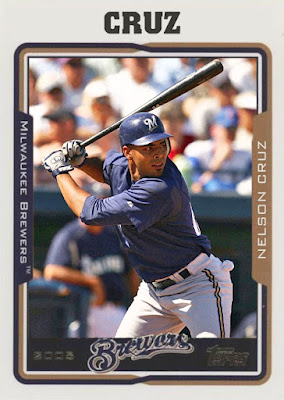
Having already been traded twice, by the Mets and the Athletics, Nelson Cruz was hoping for a slightly more permanent home when he arrived in Milwaukee in 2005. He didn't quite have a place in the lineup yet, hidden behind Carlos Lee and Geoff Jenkins, but he managed 8 games in the majors, only coming away with 1 hit in 7 plate appearances. Fatefully, he'd leave town again, being traded alongside Lee to the Rangers, where he'd have a larger come-up. 

Knowing where Cruz's career would take him, it's very funny that he was seen as a lowly little prospect inn Milwaukee one time. I kinda wish Topps would have documented it, but it's something I can do.

Rick Helling was one of the premier starters for the Rangers in the 1990s, winning 20 games in 1998, and winning 68 games overall for Arlington. His numbers as a starter dipped in stints with Arizona and Baltimore, he didn't make a roster in 2004, and people assumed that was it. But, lo and behold, in 2005, Telling reemerged in Milwaukee as a swingman. While his relief numbers in August were alright, he was made a starter again in September, due to lack of other options, and impressed mightily, with a 1.69 ERA and 32 Ks in 6 starts. His 1.9 WAR was his highest since leaving Texas. And while the 2006 season, a down one, would be documented by Upper Deck, Topps wouldn't touch his Milwaukee years, which is a shame.
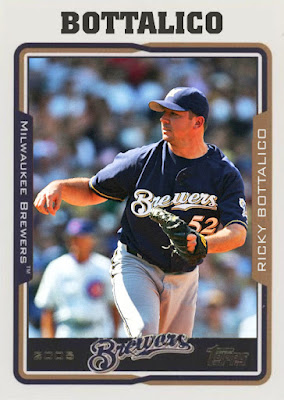
The strangest one I have is a sunset card for a 90s fringe closing hero. Ricky Bottalico was the closer for the Phillies in the late 90s, and was a definite character for those teams, as well as some Cardinals and Royals teams in that era. He eventually mellowed into a solid middle relief man, which was not at all what Topps was interested in documenting, so they went sort of cold on his trail for the last few years of his career, including a return to Philly. In 2005, at 35, he played his last games for the Brewers, and did alright, with a 4.54 ERA in 40 appearances. He tried making camp with the Orioles in 2006, but that didn't work out for him. 

Crazy stuff, right? Tomorrow's batch will come from the 2006 Championship Cardinals team.

Friday, November 5, 2021

Topps Cards That Should Have Been: 2005 Braves

As the 2021 Braves celebrate their championship season, let's go back to a humbler time for the team- 2004, after their division title and botched playoff attempt, when they were beginning to shed their late-90s cred and morph into a more middling squad for a few years. 

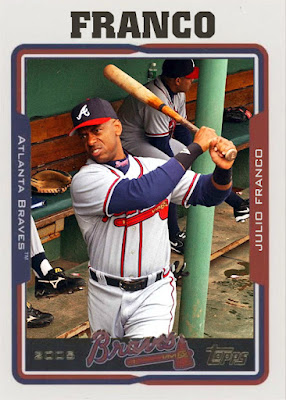
One of the perennial stars of these mid-2000s Braves teams was Julio Franco, who had been a crucial bench piece for Atlanta since returning from Korea in 2001. Franco played over 100 games a year for the Braves from 2002 til 2005, which is a pretty bold claim for a guy in his early to mid-40s, who had played alongside Toby Harrah, Gorman Thomas and Bert Blyleven as a rookie. After a strong 2004, '05 was a step back for Franco, who hit .275 with 42 RBIs, including a second-act-high 9 homers, in 108 games. This would be his last full year in Atlanta, but he'd come back in 2007 for a stint that Topps would also fail to document.


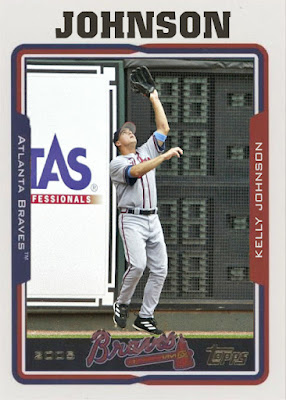
We also have two big-deal rookies for the Braves in '05 that Topps ignored. One was Kelly Johnson, who'd become a big piece of the Braves' late-2000s teams. In his rookie campaign, Johnson hit .241 with 40 RBIs and 9 homers [...that's kinda similar to Franco's], and had a 1.4 WAR over 87 games. Though he'd miss all of 2006, he'd become a staple in the seasons following.


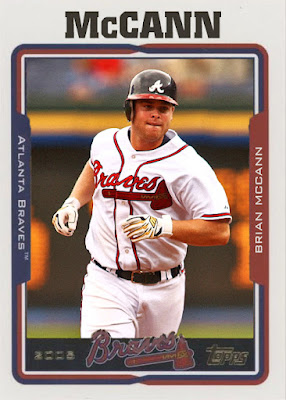
As would another rookie, Brian McCann, who also made his debut in 2005. McCann played in 59 games, mostly as a backup to Johnny Estrada but also as injury insurance, and made his case known pretty early on, hitting .278 with 23 RBIs and 5 homers in 59 games. Perhaps a bit lower-key than the following six straight All Star seasons, but definitely a solid start to a long, impressive career for the Braves. 

Tomorrow, we stay in the same year, but cover a lot of very strange additions to the fold in Milwaukee.

Tuesday, July 13, 2021

Topps Cards That Should Have Been: The 2005 All Star Game

 The first year where Topps printed cards of the year's All Star Game during that calendar year was 2005, in Topps Updates and Highlights. Unfortunately, they only did cards of the starting lineups, and neglected to print any of the reserve members and bench players. Topps would rectify this starting in 2006, and would begin to be extensive in their ASG coverage as the years went on.

But we're left with 2005, a fragmented portrait of an ASG that once was. So, as the first of this project since the 2020 Final Edition set, I figured I'd rectify the missing pieces, and present the 2005 All Stars that never made it to Topps Update.

Moises Alou, San Francisco Giants: 1-1, 2B, BB

Garrett Anderson, Los Angeles Angels: 0-2, K

Danys Baez, Tampa Bay Rays: Did not play

Jason Bay, Pittsburgh Pirates: Did not play

Miguel Cabrera, Florida Marlins: 0-2, RBI 

Luis Castillo, Florida Marlins: 1-3, Single.

Matt Clement, Boston Red Sox: 1 IP, 0 hits, 1 BB, 1 K.

Bartolo Colon, Los Angeles Angels: 1 IP, 1 hit, 0 runs

Chad Cordero, Washington Nationals: 0.1 IP, 1 K, 0 runs.

Justin Duchscherer, Oakland Athletics: Did not play

Morgan Ensberg, Houston Astros: 0-2, K

Jon Garland, Chicago White Sox: 1 IP, 2 BB, 0 runs, 0 hits

Luis Gonzalez, Arizona Diamondbacks: 1-1, RBI double. 

Livan Hernandez, Washington Nationals: 1 IP, 2 hits, 2 ER, 1 BB.

Shea Hillenbrand, Toronto Blue Jays: 1 inning defensive substitution, no at-bats.

Paul Konerko, Chicago White Sox: 0-1, K

Carlos Lee, Milwaukee Brewers: 0-3, K, RBI

Brad Lidge, Houston Astros: 1 IP, 0 runs, 0 hits, 3 K.

Paul Lo Duca, Florida Marlins: 0-2

Felipe Lopez, Cincinnati Reds: 1-1, Single

Melvin Mora, Baltimore Orioles: 0-1, K

Joe Nathan, Minnesota Twins: 1 IP, 2 hits, 1 ER

Roy Oswalt, Houston Astros: 1 IP, 2 hits, 2 ER, BB, K

Jake Peavy, San Diego Padres: 0.2 IP, 1 hit, 0 runs, K

Scott Podsednik, Chicago White Sox: 1 inning defensive substitution, did not bat

Mariano Rivera, New York Yankees: 0.1 IP, 1 K, Save

Kenny Rogers, Texas Rangers: 1 IP, 3 hits, 2 ER, K

Jimmy Rollins, Philadelphia Phillies: 1-1, single

B.J. Ryan, Baltimore Orioles: 0.2 IP, 1 hit, 1 ER.

Johan Santana, Minnesota Twins: 1 IP, 1 hit, 0 runs, BB

Gary Sheffield, New York Yankees: 0-1

John Smoltz, Atlanta Braves: 1 IP, 2 hits, 1 ER, HR, Loss

Alfonso Soriano, Texas Rangers: 0-1, 1 run as a pinch-runner

Ichiro Suzuki, Seattle Mariners: 1-2, single, RBI

Mike Sweeney, Kansas City Royals: 0-1, K

Billy Wagner, Philadelphia Phillies: Did not play

Bob Wickman, Cleveland Indians: 1 BF, BB, 1 ER

Dontrelle Willis, Florida Marlins: 1 IP, 2 hits, 2 ER, BB

Michael Young, Texas Rangers: 1-1, 2B

That should be everybody except for Jason Varitek, who I already did one of in his solo Topps Cards That Should Have Been post a while back. Hope this was amusing for some of you.