Showing posts with label 2004. Show all posts

Tuesday, March 1, 2022

Topps Cards That Should Have Been: The Last Expos


On the day that the result of a new collective bargaining agreement could either save or doom the season, I wanna take you all back to 2002. 

I'm not sure if a lot of people remember this, but in 2001, Bud Selig wanted to contract the league and eliminate the two lowest-drawing teams, which, in 2001, were the Montreal Expos and Minnesota Twins. After the city of Minnesota said 'like hell you will', the Expos, while saved for the moment, were still on the bubble. They were harmed by infuriating ownership practices [courtesy of Jeffrey Loria], a downturn in their core despite a productive trade deadline in 2002, and, of course, a market that couldn't be bothered. There were still Expos loyalists, but by 2002 they were far and few. 

The only thing that kept the Expos in the MLB was the renewed collective bargaining agreement, which kept the league at 30 and instead led the league to consider relocating the team. The CBA here is the reason we have the Nationals, and that this franchise eventually found a ring. Holding out on the players and fans, and their concerns, solves nothing. 

And so the Expos played two final seasons as the Expos. I call these the 'death nell' years because it was clear the MLB wanted them out of Montreal, and they even went so far as make them play home games in San Juan, Puerto Rico. The writing was clearly on the wall for the team, and I consider these teams the end of the road for the team. Hell, in 2003 they were close to playoff contending when the MLB, who OWNED THE TEAM AT THAT POINT, basically locked their roster at 25 in September, essentially to ensure they wouldn't win NOW and draw in fans. That is not the sign of a prospering market.

So in this post, I'm including Expos that Topps left out in 2003 and 2004, because, unsurprisingly, by following the MLB narrative on the season, Topps must not have seen many true heroes worthy of making cards of in these seasons. 

Most confounding is Livan Hernandez, dealt to the Expos for nothing after bombing out of a job in San Francisco. Hernandez, the former 1997 World Series breakout, was the top WAR earner for the Expos in 2003, with a 15-10 record, a 320 ERA and 178 Ks in a full season of 33 starts. How the HELL do you just not make a card of that? He was clearly a standout by the time Update was happening? Why be so deliberate in erasing the narrative?


Similarly bafflingly, Topps didn't make a card of the Expos' starting catcher in these farewell seasons either. They made a Michael Barrett card in 2003, but he got traded to the Cubs midway through the year. Brian Schneider, meanwhile, became a steady backstop for the Expos. While he was around replacement level in 2003, hitting only .230, Schneider had a strong year in '04, with the third highest WAR on the team with 3.5, 112 hits and 49 RBIs in 132 games. He came off as reliable and trustworthy as a catcher, which is why the team would keep him on upon moving to Washington. 


Similarly absent from these sets was super-ute contact hero Jamey Carroll, known for scoring the last run in Expos history. Carroll was a defensive upgrade from Fernando Tatis at third in '03, playing 105 games and hitting .260. In '04 he'd be trapped behind Jose Vidro and Tony Batista for starting positions, but would be a bench bat extraordinaire, hitting .289 with 63 hits in 102 games. From here he'd fill a similar role with the Rockies. 


Also absent in both sets was relief specialist Luis Ayala, who was a very big piece of these late teams for the Expos. In 2003 he had 10 wins as a reliever, a 2.92 record and 46 Ks in 65 appearances, going for saves in 5. While not having as strong a W/L ratio in 2004, he'd be equally hard on opposing offenses, with a 2.69 ERA and 63 Ks in 81 appearances. Ayala would make the trip to Washington, and would eventually bop around the leagues as a solid cheap relief option. 


As for closing options during these seasons, I have to say that the Expos did pretty well both times. In 2003 they had Rocky Biddle, who came over from being a middle reliever with the White Sox, and, being thrust right into the ninth, notched 34 saves, despite some rocky numbers otherwise. He did get a Topps card in 2004, but by then he was struggling even more and had to vacate the ninth. Enter young whiz kid Chad Cordero, who would make the most of this promotion with a 2.94 ERA, 14 saves and a full 83 Ks over the course of the season. Of course, the Nats would lock him down as closer, he'd be a fearsome force and All-Star, and then would be injured far too young and never have a closing job again. 

An all-star with Montreal in 1994, Wil Cordero would be the Expos' starting 1st baseman in 2003. In 130 games, he'd hit .278 with 71 RBIs, his highest since his 72 in 1997, and 121 hits. A solid season, if marred by sliding defense. Topps, of course, would look the other way. 

In a post where there wouldn't be too many actual big pieces to document, you'd see a lot more ones like this one- Todd Zeile was traded by the Yankees to the Expos midyear, and as a backup 3rd baseman he hit .257 with 19 RBIs and 5 homers in 34 games. He'd essentially be starting by the end, which would pave the way for a decent year as position-warmer-for-David-Wright in 2004. 

As for the 2004 team, they had former Indians and Rangers backstop Einar Diaz as a backup. He was decent, hitting .223 in 55 games with above-average defense, but by this point Schneider was having the better season. 

I think it'd be pretty fitting if we ended on Terrmel Sledge. As the Expos' starting left-fielder he'd be adequate, hitting .169 with 107 hits, 62 RBIs and 15 homers. In Vladimir Guerrero's absence, Sledge was the true power bat of the outfield, and he was alright at that. The reason I'm ending with Sledge is that, upon the team's move to Washington, he would hit the Nationals' first ever home run. The ball was on display in Cooperstown for a bit, I think. One of those career trivia question guys, but still a great run with the Expos.

Part of me hopes baseball returns to Montreal someday. Part of me hopes there's a market for it. 
Monday, January 24, 2022

Topps Cards That Should Have Been: 2022 Hall of Fame Class Edition


Like last year, we celebrate the impending Baseball Hall of Fame inductions with a run through the uniforms that should have been depicted on cards, regardless of how brief or perfunctory they were.

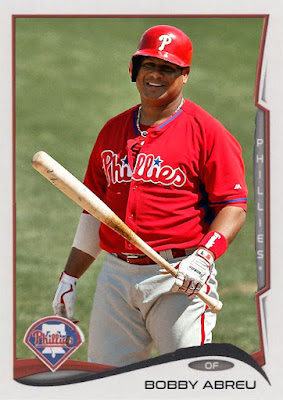
I should have included this in last year's bunch, but in 2014, Bobby Abreu signed a minor league deal with the team that made him a household name, the Philadelphia Phillies. The majority of his supremely underrated Hall of Fame case came from his Phils days, and having him back, even at the end of his career, was a cool move. Though Abreu spent the Spring with the Phils in Clearwater, he did not make the team, and would eventually sign a deal with the Mets, which would go surprisingly better for him rounding out his career. Still...wouldn't it have been awesome to see one more Phils Abreu card? It would have felt the same as 2012 Topps' Jim Thome Phils card.

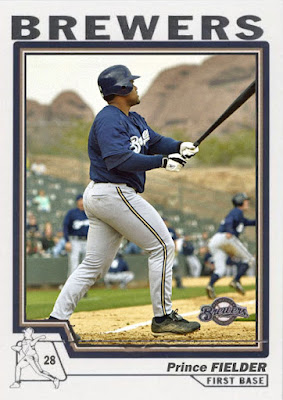
Zipping us back to the top with the new additions to the ballot, most of whom may not make more than 5% admittedly, while I already made a 2005 Topps card of Prince Fielder back in November, I did not make one to commemorate his 2004 Spring Training sting. While Fielder was still a year or so away, he did have some solid numbers out of camp for the Brewers, but he was still blocked behind Lyle Overbay for another year. He'd eventually own first base and become a fixture to round out the decade.

Justin Morneau's 2004 issue would have been more crucial, as Morneau would be an important part of the Twins' infield that year, playing 74 games, hitting .271 with 19 homers in that time. Unfortunately, Morneau would only get cards from Topps in Heritage and Total, skipping flagship altogether. A bit of an odd exclusion, given his appearances in 2003 and 2005 sets. Nevertheless, from 2005 on, Morneau would be a strong, consistent piece of the mid-2000s Twins teams, culminating in a 2006 MVP win that I'm still kinda bitter about.
While Jonathan Papelbon's rookie card was in 2006 Topps, he was used out of the pen during 17 games in 2005, and did fairly well, with a 2.65 ERA and 34 Ks. Of course, the very next season Papelbon would get the ninth inning and become a hero in Boston. Before...y'know...pissing off Philly and Washington.
In 2016, Joe Nathan was coming off a disappointing campaign in Detroit, and after amassing all star nominations as a Twin and Ranger, was coming down big time. Midway through the season he signed a deal with the Cubs, as they embarked on their championship campaign. He only pitched in 3 games for Chicago, but struck out 4 and gave up no runs. The Cubs did release Nathan shortly afterwards, and he wasn't finished. 
So he decided to return to San Francisco, where he'd spent his early career. As a Giant, in September, Nathan pitched in 7 games, struck out 5 out of 18 batters, and continued his scoreless streak. He ended the season with a 0.00 ERA, which was strong enough numbers to go out on. While I doubt Nathan will get into the HOF, he was still an excellent closer and relief asset, and still had some stuff left in the tank even at the end.
And finally, we come to Jimmy Rollins as a White Sox. After his Dodgers deal went disappointingly, Rollins' stock declined, and could only muster a minor league deal with the tanking ChiSox. The best you can say for J-Rol here is that he was an impressive prelude to Tim Anderson, hitting .221 with 33 hits and 8 RBIs in 41 games. Once Anderson was called up, there was really no reason for Rollins to be on the roster, and he was quietly released, tying up his 17 year career there. Of all the newbies on the ballot, I have the highest of hopes that Rollins can someday make it to the Hall of Fame, even as unlikely as that seems. He was always a favorite, and always seemed to be an elite shortstop.

Tomorrow...I am actually gonna do an Unofficial HOF Ballot post. It's gonna be...something, alright.

Wednesday, February 3, 2021

Topps Cards That Should Have Been: 2004 Topps Raul Mondesi


The career of Raul Mondesi is one that most collectors know of...to a degree. Like...Rookie of the Year with the Dodgers in 94, big hitting years for LA and Toronto, lands in New York in 02, then can't stay in one place for the rest of his career. 

Topps, to their credit, did document Raul Mondesi's stints on the Yankees, Diamondbacks, Pirates and Braves. But...one slipped through the cracks. The most boring one.

In May, after the Pirates have already released Mondesi after hitting [checks notes] .283 WITH 14 RBIS IN 26 GAMES??? WHY THE HELL WOULD THEY RELEASE THAT? Was he just making the rest of the team look too good???

Jeez. Anyway. The Pirates foolishly release Mondesi, and he signs with the Angels, who...apparently need outfield help? With...Garrett Anderson, Vladimir Guerrero and Jose Guillen starting? This is making less and less sense the further I get into it.

This part does make sense- in 8 games with the Angels, Mondesi hits .118 with only one RBI, a home run. It's a very unspectacular run, and the Angels release him just as quickly as they pick him up. Because he's been released way before Topps' Traded deadline, they just don't put him in the set at all. Figures. They do give him a Braves card in 2005 for some reason, but...maybe they were just being nice.

Sunday, January 31, 2021

Topps Cards That Should Have Been: The Gregg Zaun Chronicles

 I don't know if you guys have been keeping track, but January I was doing these Topps Cards That Should Have Been posts in alphabetical order. Just a little challenge. Ah, let's see if I can do a Q name, so on, things like that.

So that should explain why I'm posting a ton of customs of switch-hitting backup catcher Gregg Zaun on the last day of January.

......look, it was either him or Todd Zeile.

Nevertheless, there is a lot of things to talk about regarding Gregg Zaun and Topps' gaps in documenting his career on cards. It may be a niche guy to include, but he played throughout the 2000s and was a reliable choice for catcher when other guys wouldn't do. 

As this project starts in 2000, we begin with Gregg Zaun's 2000 season in Kansas City. In 83 games he hits .274, and the starting gig is his for a bit.

Flash-forward to 2003:

Zaun spends 2002 in Houston backing up Brad Ausmus, which he continues to do for 2003, as he hits .217 in 59 games as backup. That doesn't seem to cut it for Houston, and they release him. 

Only for the Colorado Rockies, who need a solid backup option for Charles Johnson, to pick him up. Zaun does miles better with the Rox, hitting .261 with 3 homers in 15 games. 

Then, in 2004, Gregg Zaun figured out that the key to his longevity in the bigs would be playing in Canada. So he signed a minor league deal with the Expos, which would have been an opportunity to play in Montreal in their last season. However, the Expos had Brian Schneider, strike one, and they were going forward with Einar Diaz as a backup, strike two. Which means the Expos had no use for Gregg Zaun, and released him.

About a week into the season, the Toronto Blue Jays realized that their catching options, including Kevin Cash and Greg Myers, were too thin, and they went...not far, and got Gregg Zaun. Zaun quickly became the starting option in Toronto, hitting .269 in 107 games with a 2.3 WAR. Here, Zaun's scorching run in Toronto begins, and the Jays fans couldn't be any more here for it.

Topps, on the other hand, seems to miss the boat. No Zaun cards in Update, which is a foresight, even if it is a low-tier Jays team.

It becomes even more infuriating in 2005 when Gregg Zaun has his best season. Yeah, that's right. Out of all the hitters in Toronto in 2005, including Vernon Wells, Orlando Hudson, Eric Hinske, Alex Rios and Aaron Hill, you know who has the highest WAR? SWITCH-HITTING CATCHER GREGG ZAUN. He only hits .251 with 61 RBIs, but his defensive numbers are so impressive that it propels him to a 3.6 WAR. Which is huge. No longer the backup, Zaun has a beautiful year in Toronto, cements his status as a Canadian legend, and doesn't have to worry about moving around for a bit.

After this season, Topps listens up and makes Gregg Zaun cards in flagship for the next 4 seasons. Zaun is the primary option at catcher for the Jays for the next few seasons, then in 2009 he signs with the Orioles to start. Only problem is that in 2009, the Orioles bring up a guy named Matt Wieters to play catcher, and Zaun's numbers aren't enough to stop him from usurping his playing time. So the O's trade him.

Thankfully they trade him to a decent team that needed catching options behind Dioner Navarro. So Gregg Zaun gets to compete with the Rays. Unfortunately, thanks to a dismal September, the Rays don't make the postseason. Zaun still hits .287 with 14 RBIs in 34 games. The trade happens after the Update cutoff, so no Topps card. In fact, Topps kind of checks out as far as Zaun is concerned.

In 2010, the Brewers sign Zaun to look over the two burgeoning catchers they have, George Kottaras and Jonathan Lucroy. Zaun's 39, he's clearly just doing this to play, not really worrying about numbers. He actually does fairly well, hitting .265 in 28 games. He's still a decent defender but he's...39. On May 20th, he gets injured, sits out the rest of the season...and it's not looking good for him as a defensive catcher. 

Zaun would try one more season, signing a minor league contract with the Padres in 2011. Just to see if anything was left in the tank. He tried his best, but he really couldn't find any of his former strength left, and retired out of camp. Dignified way to leave, but he did it on his own terms.

And he's been a Jays broadcaster ever since, which means, yes, Toronto has been very kind to him. For a guy who was thinking he'd be a backup in different cities, Gregg Zaun sure found a stationary home there, which is nice.

Wednesday, January 27, 2021

Topps Cards That Should Have Been: The Jason Varitek Chronicles


One of my goals with this project has been to right the various wrongs Topps has gone through with over the past 20 years, be it with omissions or contract issues or the like. One of the big ones that subsided right when I got into the hobby was that of Jason Varitek, the longtime Boston backstop.

From the beginning of his career until 2007, Jason Varitek did not have a contract with Topps, and therefore received absolutely zero Topps cards. The humanity. 

And let's be fair- for the first few years of his career, Varitek was a replacement-level catcher who got by on decent seasons, and he doesn't start truly tearing up the league until 2003, so it wasn't a huge loss til around then. But still, Topps not making any cards of the catcher of the Boston Red Sox is a big deal, and one that I had no choice but to rectify.

So, starting in 2001, here they are. In 2001, Varitek mostly backs up Scott Hatteberg but hits .293 in 51 games. 

2002 is Varitek's first season with a WAR over 2, as the catching gig is all but his thanks to him playing 132 games behind the plate, hitting .266 and notching 61 RBIs. Not pristine, but he's beginning to benefit from being on the Sox with Ramirez, Damon and Ortiz all at once.

2003 is the breakout year. Tek hits .273 with 25 homers, a career high for him, 85 RBIs, another career high, and his first ASG appearance. He also gets MVP votes, postseason playing time, and a stranglehold on the position . Here is where Topps starts really regretting not signing Varitek to a contract.

And they begin to regret it even more in 2004, another strong year for Varitek with a .296 average and 73 RBIs, one that would see him win his first of two World Series rings. Tek has 11 postseason RBIs for the Sox, and cements himself as a reliable, necessary presence in the Boston dugout. 

So...Topps can't even make a card for the catcher of the World Series champions. Awkward.

It gets worse. In 2005, Varitek has his most impressive season yet, getting a gold glove, a silver slugger, more MVP votes, a 70-RBI year AND...

His second ASG appearance, marked by a card that would have shown up in 2005 Topps Update. This would have been a cool one, too, as it represents a great RBI moment from that ASG. 

And in 2006, Varitek would wind things down with a .233 average in only 106 games thanks to an injury [Doug Mirabelli would be on hand to back up]. 

2007, he'd have a posed shot against the Sox's maroon background, and from then on Topps would be on top of things giving him flagship releases. Again, I wish they'd acted sooner, but there's a lot you can't control about Topps. 

Monday, January 25, 2021

Topps Cards That Should Have Been: The Salomon Torres Chronicles


More with Topps' vendetta against relievers.

From 2002 until 2008, Salomon Torres was one of the most consistent relievers in the NL Central, averaged a 3.61 ERA with 381 strikeouts and 57 saves, and was a middle relief rock for a market that was anything but consistent. 

However, you probably never knew that for five of those years because A.) Torres was a middle reliever and B.) Torres played for the Pittsburgh Pirates.

Topps would mostly shrug through issuing Pirates cards every year of their mediocrity in the mid-2000s. A lot of Pirates that'd show up in Topps sets in this period were educated guesses. Sure, maybe this veteran will have a good season there, maybe this rookie. Meanwhile, people like Nate McLouth and Ryan Doumit didn't get cards as Pirates until they were about to be traded, essentially. And people who deserved them, like Salomon Torres, got none in flagship. 

Heck, pulling a card of Torres' in 2004 Total was how I learned he'd hung on as a Pirate to begin with. I knew Torres from being a high-profile rookie in the mid-90s, making the cover of 1994 Stadium Club Series 3, and being a highly-touted Dominican prospect that didn't pan out in SF. So he bopped around the leagues, sat out for 3 years, had a comeback in Korea and starting in 2002 was a mainstay in the Pirates bullpen.

2003 was the first Torres year I could get images from. This season Torres was still being partially utilized as a starter but eventually moved to the bullpen, where his ERA would even out to 3.20 in 25 appearances. From here, the Bucs knew what to do with Salomon Torres.

In 2004, Torres raised his productivity, pitching in 84 games with a 2.64 ERA. His 2.3 WAR that season would be a career high. 
2005 was similar- 2.76 ERA in 76 appearances, and still one of the better performers on the team. 

In 2006 Torres pitches in a league-high 94 games, and gets a 3.28 ERA with 72 strikeouts. The league is recognizing Torres' versatility and consistency, even if Topps won't. 

And in 2007, Torres powers down a bit with a 5.47 ERA in 56 games. Though in the past two seasons he's accumulated 24 saves, he's still a middle reliever and his 2007 struggles seem to point to the end of his era in Pittsburgh. 

After the 2007 season, he's traded to Milwaukee for a pair of prospects. Milwaukee rewards Torres by giving him the closing gig and letting him save 28 games with a 3.49 ERA. Topps rewards Torres by finally, FINALLY including a base card of his in Update. I think it's very telling that they waited until he joined a team that was A.) playoff-contending and B.) not the Pirates in order to do this, but thankfully they gave him the final sendoff he needed. 

Wednesday, January 20, 2021

Topps Cards That Should Have Been: The Quinton McCracken Chronicles

Quinton McCracken was one of those guys that just lived to play for expansion teams. He was drafted by the Rockies, was an Opening Day member of the Devil Rays, and was a fan-favorite member of the early-2000s Diamondbacks teams. We're one Marlins signing away from a full 90s expansion bingo card, though that never happened. 

McCracken was one of those high-steals low-offensive-production guys that Topps never knew what to do with. In 2004, he got a card as a member of the Seattle Mariners, a badly photoshopped-background card at that. While he did play a good portion of the 2004 season with the Ms, he was released in June, and promptly re-signed with the team he'd just been traded from to begin with, the Arizona Diamondbacks. So he proceeded to spend two more years as a bench bat there.

In 55 games with the D-Backs in '04, he hit .288 with 45 hits and 13 RBIs. Most of all, he was home, and it felt good to be home.  


The same concept continued in 2005. He played in 134 games, first off the bench and eventually as a full time center-fielder as a replacement for Jose Cruz. He hit .237 with 51 hits and 13 RBIs. It was a last hurrah of sorts for McCracken. He was 34, things were winding down, and it wasn't looking like the D-Backs would re-sign, so he was just enjoying himself. 


In 2006, he gets signed to a one-year deal with the Reds, which...is odd. Those 00's Reds vests on an expansion hero are...weird to me. Anyway. Mostly a bench guy that year, McCracken hit .208 with 11 hits in 45 games. The Twins would sign him at the tail end of the 2006 season but he wouldn't play at all. Thus ending his career.

Fun little player. Probably one of the best known MLB players whose name starts with Q. 

Monday, January 18, 2021

Topps Cards That Should Have Been: The Rey Ordoñez Chronicles

 Rey Ordoñez, for those unaware, was one of the core members of an infield that MLB Network once voted one of the greatest of all time. For a shining few seasons in Queens, the Mets were protected by the infield combo of John Olerud, Edgardo Alfonzo, Rey Ordoñez and Robin Ventura. In 1999, the four of them combined for 21.1 WAR, with Alfonzo, Olerud and Ventura scoring WAR over 5. Ordoñez only had a 2.8, but was no slouch, capping off his third straight gold glove and his career-high 60 RBIs in 99.

After the World Series team subsided, Ordonez and Alfonzo left in 2002. Eddie went to San Fran and had a steady gig for a few years. Ordonez bounced around, spending 2003 with Tampa, and botching a 2004 spring training audition with the Padres, picked up by Topps despite him never playing a game there. 

But, eventually, an MLB team did call upon the services of the once-strong shortstop, and the Cubs came calling in 2004, signing Ordoñez in May. In 23 games, Ordoñez hit .164 with a negative WAR, and was released after about a month of service. As he was gone before Update went to press, Rey Ordonez' time in Chicago never made it onto a Topps card.

It's not the official end of Ordoñez's story, however...


Yes, in 2007, three years after playing his last MLB game, Rey Ordonez tried to break back into the majors one last time with the Seattle Mariners, a team that would eventually start Yuniesky Betancourt at short. But Ordonez persevered, doing his best in Spring Training despite being one of the last members of the 2000 Mets team left in the majors [Benitez, Piazza, Hampton and Payton were all winding down]. The gig didn't work, and the Mariners didn't give him a major league run at things, which means Rey Ordonez wasn't even good enough for the 2007 Mariners by the end, but it's an interesting 'what if' scenario. 

Actually...hell, since we're talking about spring training attempts by former Mets infielders, I've got one more, and it's very relevant: 


Yeah, turns out Rey Ordonez wasn't the only member of that infield to try to break back in. 

In 2008, Edgardo Alfonzo, whose last game was in 2006 with Toronto, auditioned for a role with the 2008 Rangers, a low-level team that was beginning its trek back to relevance thanks to Josh Hamilton and later Elvis Andrus. He was 35, not to the level he was with the Mets, and just wanted a chance to play again, even for someone like the Rangers. Like Ordonez, Fonzie didn't get very far, and was cut before the season began, but we still have this picture of how the Rangers could have gone with things. 

Friday, January 15, 2021

Topps Cards That Should Have Been: The Hideki Matsui Chronicles


If I were collecting in 2003, I'd be miffed.

Hideki Matsui, one of the most fearsome sluggers in Japanese league history, signs with my team, the New York Yankees, and Topps doesn't sign him to a deal. Upper Deck, Donruss and Fleer all do. But Topps, the most important card retailer in the business, can't court Matsui to a deal. So in 2003, while Upper Deck, Donruss and Fleer are producing tons of rookie cards of the slugger, Topps is just...shrugging. Going 'how about Jose Contreras?' 

It always pisses me off when Topps can't sign someone to a card-producing deal, because I'm a Topps-reliant collector, and I like seeing everybody in a Topps set and using that as my base for that player's year. And if they're not gonna do cards of, oh I dunno, THE MOST IMPORTANT JAPANESE EXPORT OF 2003, then what's the point?

So yes. Hideki Matsui makes it to New York in '03, and immediately hits the ground running, hitting .287 with 106 RBIs and 179 hits. He makes an all-star team, plays all 162 games, plays in a World Series, and loses Rookie of the Year to Angel Berroa for some strange reason.If Topps were to have put a Matsui rookie card in flagship, it would have looked like that- a shot of Matsui fielding specifically for card companies to have an action shot. That would have been enough for us. 

2004 is another strong year for the hitter affectionately referred to as Godzilla- he hits a career-high 31 homers, hits .298 with 108 RBIs, makes ANOTHER All-Star team, and finishes the season with a 5.0 WAR, higher than all Yankees that aren't A-Rod. Topps once again isn't making cards of Matsui this year, which is sucky, but UD, Donruss and Fleer all still do.

In 2005, Matsui FINALLY signs a contract with Topps, and from '05 until 2010, Matsui has tons of Topps cards, remains a solid MLB hitter and wins a World Series. 

Then, in 2011...the contract runs out. And Matsui and Topps don't agree on a new deal. Which means, for the last two years of Matsui's career...NO ONE is making cards of him. 

While Matsui's final two seasons aren't to the caliber of his Yankee years...we could have at least had SOMETHING. Anything. Like...2011, Matsui plays 141 games with the Oakland Athletics, in a starting role. He hits .251 with 72 RBIs and 130 hits. Not great, but he's still one of the chief figures of the A's season, and a Topps card of him would have made sense. Of course, no contract, no cards. So we suffer.

In 2012, Matsui doesn't sign with a team until one desperately needs him, and in late April he signs with the Rays. In 34 games, he hits .147 with only 7 RBIs. Clearly, his best days are behind him, and he retires after the season. And, again, Topps could have made a cool final tribute of Matsui, but it doesn't happen. 

In 2017, Topps signs a contract to produce cards of Matsui as a legend. He also signs with Panini, because nyah. Matsui has been on cards ever since. And yet Topps will probably never rewrite the years they missed with Matsui, because....I dunno, money or something.