Showing posts with label Chad Bradford. Show all posts

Wednesday, July 17, 2024

Topps Cards That Should Have Been: The 2002 Moneyball A's


It's funny, the other day Disney+'s twitter account posted that Angels in the Outfield was finally on streaming, and that was a big deal because that movie had never been officially available on streaming before, despite being a bonafide Disney product. I dunno if it was rights issues, MLB stuff, who knows. But it had been 20 years or so, so I gave it a watch. And while it's not great, it still has a lot of really fun moments, and the last act really works. Clearly not the best baseball movie of the early 90s, but still decent.

And I got to thinking about the fact that everybody always talks about, like, 1988 to 1994 as this goldmine of baseball movies [killed by, like Cobb], with all the great ones that everybody loves in that window, and while there is a lot of good stuff in there...what's even funnier is that the movie that's generally accepted as one of the best baseball movies ever made is from like 15 years later. 

Moneyball is not only a movie that baseball fans enjoy, but it's a movie that movie fans enjoy. Baseball fans love it because they get to see depictions of David Justice and Carlos Pena and Scott Hatteberg, and movie fans love it because it's a great story and a really great script. This movie has immortalized obscure baseball names like John Mabry, Chad Bradford, Jeremy Brown, Ricardo Rincon and Jeremy Giambi. And it's also shed more light on just how good the 2002 A's were, even with the low-budget mentality.

It turns out I had a ton of 2002 A's Should Have Been customs premade, and so I'll roll them out here for y'all to enjoy. These are cards of integral 2002 A's pieces that Topps did not make cards of.

Chad Bradford, being one of the low-budget oddities that led to the A's success that year, needed a 2002 custom. Bradford was known for his impeccable relief numbers despite being an unconventional sidearmer. In 2002, after years of organizational neglect, he delivered his best season yet, with a 3.11 ERA, a 4-2 record and 56 strikeouts in 73 innings. This cemented Bradford's status as one of the unsung heroes of this A's team, and would pave the way for even more dominance to come with Oakland, Boston, New York, Baltimore and Tampa.

Scott Hatteberg, famously played by Chris Pratt in the film, was a former Red Sox prospect who, at 32, was looking pretty cooked. He'd been a mediocre catcher for the 90s Sox teams, and was running out of uses. The story goes that Billy Beane figured if they plotted him in at 1st they'd get a guaranteed contact hitter in the lineup, owing to the 'does he get on base' mentality, and thus Hatteberg had the best season of his career, resulting in a 3.3 WAR, a .280 average and 61 RBIs. This season would keep Hatteberg as a staple of the 00's A's squads, and would lead him to being the answer to the trivia question of 'who did Joey Votto replace at 1st in Cincinnati?'

The plan for 2nd base going into 2002 was to start Randy Velarde and throw Frank Menechino in for depth, but this wasn't a long-lasting metric. Enter rookie Mark Ellis, who was brought up a week or so into the season, and won the starting 2nd base job for the majority of the season. Though he was a .272 hitter, Ellis' defense put him above the pack, and his 2.7 WAR season placed him 8th in Rookie of the Year voting. 

The go-to outfield sub for this team, as he would be going forward, was Eric Byrnes, soon to be dubbed 'the Human Crash Test Dummy' for his ability to make unbelievable plays in the outfield without much care for his own personal safety. Byrnes played in 90 games, and had 94 at-bats, meaning he wasn't a starter, but he did hit .245 in that time, in addition to keeping the defensive side up late in games. Byrnes would funnel this into another 10 or so years of spare part excellence. 

Despite the success of Mark Ellis at 2nd, Beane still poached Ray Durham from Chicago at the deadline, in exchange for minor league pitcher Jon Adkins. Durham by this point was known as an above-average contact bat with putrid defensive numbers. Though Durham still played games at 2nd in Oakland, he was primarily used as a DH, a strategy made more impressive by the fact that this would be Durham's last season in the AL, followed by six years in San Francisco and an autumn in Milwaukee. Durham's hitting still aided the A's, as he hit .274 with 22 RBIs and 60 hits in 54 games, plus an incredible postseason, with 7 hits, 2 RBIs and 2 homers against the Twins. 


One of the most crucial scenes in the movie Moneyball is the scene where Billy Beane is able to get Ricardo Rincon from the Cleveland Indians in exchange for minor league Marshall McDougal. Rincon is the last piece the A's need to truly compete, and upon landing in Oakland, Rincon becomes one of the single best Athletics relievers in the team's history. In 25 games he posts a 3.10 ERA with 19 strikeouts and only 7 earned runs allowed. The next three years, Rincon's ERA would never rise above 4.50, and he'd appear in at least 64 games each year for the A's. Meanwhile, McDougal played in 18 MLB games, and never hit above .200. People call Billy Beane a wizard for a reason, and it's for moves like the Rincon deal. 

It's probably going to become harder to watch Moneyball after the team gets moved to Sacramento, but I still think it's an excellent film, and it's completely changed the way I view the 2002 season. Hopefully y'all will get a kick out of these customs as much as I do.

Thursday, January 27, 2022

Topps Cards That Should Have Been: 2006 Mets


Last year I talked about the strangeness of a lot of the 2007 Mets' roster leftovers. Of course, there were even more of those types if you'd checked a year back for the 2006 stuff. While some of these are sort of sensible, there's still a lot of head-scratching choices, even for a team chasing a division title. 

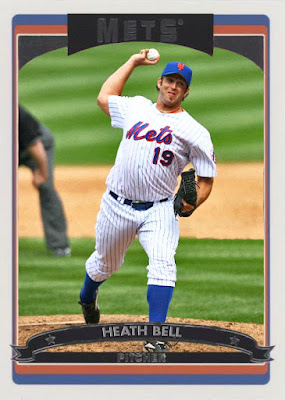
We'll start with a cool, before-he-was-relevant Heath Bell, a few years before he'd become a relief standout for the Padres. Bell pitched in 22 games, had a 5.11 ERA and struck out 35. Already he was showing signs of his future big-game power, but in a much more jammed bullpen.

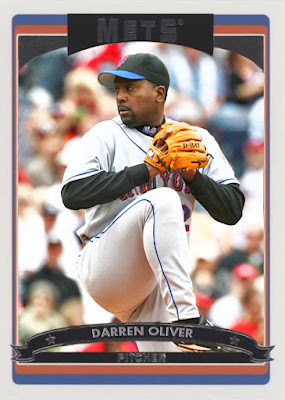
Also hanging out in the Mets bullpen that year, and also not produced by Topps, was Darren Oliver, 35 years old and still approaching peak relevancy with Texas. As for his Mets year, it was pretty alright- a 3.44 ERA and 60 Ks in 80 innings. Oliver was the 2nd-most-productive reliever in the pen, behind Aaron Heilman and was used mainly as a long relief man, as opposed to inning-long setup work. Still, after a season in the minors, Oliver's 2006 would show teams that he still had some stuff left, and he'd be a bullpen mainstay for another 7 years. 

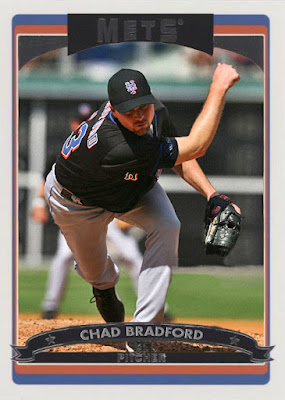
And since we're still on the bullpen, how about 2000s relief icon Chad Bradford? Bradford had a Topps Total card in 2005, and some Upper Deck issues in 2008, but Topps would just stop making cards of Bradford, as it was too tiresome for them to produce cards of a sidearming, beloved relief piece. Anyway, Bradford's sole year in Queens produced his lowest ERA since his come-up in Oakland, with a 2.90 ERA year, plus 45 Ks in 70 games. Bradford joined Pedro Feliciano, Duaner Sanchez and Billy Wagner in providing a killer bullpen front for the Mets that year, before Bradford would be sent to Baltimore.

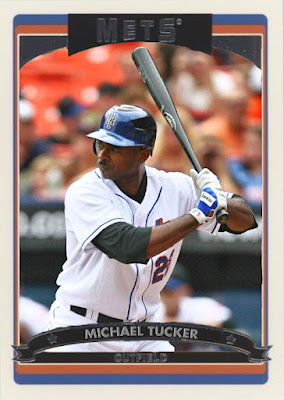
Longtime Braves and Royals outfielder Michael Tucker bopped around for a bit after leaving the Royals for the second time, ending up in places like San Francisco and Philly, before bowing out with the Mets in 06, at 35. In 35 games, he hit .196 with 11 hits and 6 RBIs, alongside average outfield numbers. He was a slightly intriguing backup choice, but didn't do much with the team at all. I will add, though, that Tucker was a postseason bench bat, and provided 2 hits and a steal against the St. Louis Cardinals in the NLCS. Even in his last-ever MLB games, Michael Tucker was a killer contact man.

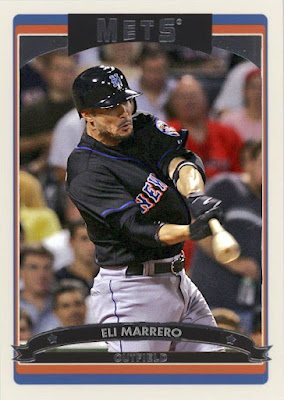
I talked about this a few months ago when I discussed the 2006 Rockies, but 2006 was Eli Marrero's last season as well, and the former Cardinals backup catcher was still trying to make things work as a bench outfield bat. Though his Rockies numbers were okay, he'd still be trade, for Kaz Matsui of all people, and sent to the Mets. If Matsui was speedy, flexible, and defensively impressive, Marrero was...not that. He hit .182 in 25 Mets games, had just 6 hits, and was a modest-to-okay defender. By August he was off the team, and not even the Cardinals would let him keep his career alive. I do find it interesting that two other famous backup catchers, Kelly Stinnett and Mike Difelice, were utilized by the Mets that year. Certainly was the first non-Piazza Mets year since '97, wasn't it?

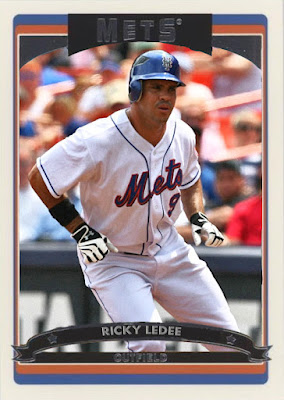
Ricky Ledee was in my 2007 Mets post, and he was with the team in 2006 as well, at age 32. Despite some decent numbers with the Dodgers during the first half, Ledee hit .094 with 3 hits in 32 at-bats, including only 1 RBI, a homer, with the Mets. Kinda shocked they kept him on for '07, honestly.

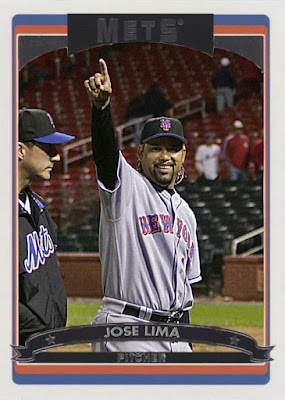
And finally...in 2006, it was Lima time in New York. After going from winning 13 games to losing 16 in the span of a season, Jose Lima was trying to hold onto his chaotic MLB energy, and signed with the Mets to keep starting games. In 4 starts, he had, well, 4 losses, 12 Ks and a 9.87 ERA. Not even his fan-favorite energy could save him there. After leaving the Mets, his desire to keep playing would lead him through the minors, and even to the Korean leagues, before meeting a sad end due to a cardiac arrhythmia. 

I'll try to keep throwing up extra customs these days, I've still got a bunch left over. 

Friday, August 28, 2020

Topps Cards That Should Have Been: The 2008 Chad Bradford Chronicles

Topps SHB #5: 2008 Chad Bradford, Baltimore Orioles
 I credit the movie Moneyball for clueing me into a lot of the more niche aspects of 2000s-era baseball, and niche players like Scott Hatteberg, Carlos Pena, Ricardo Rincon, Billy Koch and Jeremy Brown. Perhaps the biggest 2002 Oakland A's oddity whose stock grew after this movie was Chad Bradford, the sidearming reliever whose janky motion turned away several GMs [but not Billy Beane].

I've heard of people collecting him contemporarily, especially Nick from Dime Boxes, just for how refreshing  of a player he was in this era, despite being woefully underrepresented on cards.

Well, his final full season in 2008 was similarly unrepresented. Upper Deck made a card of him with Baltimore, where he started the season and played in 2007 as well, but Topps did not. A lot of the 2008/2009 entries in this project  were covered by UD in some way, but not Topps flagship, which says a lot about both companies in this point.

Anyway, Bradford was still a relief asset for teams in 2008, and posted a 2.45 ERA in 47 appearances, some career numbers for him in his seasons since his 2001 breakout. His strikeout numbers had diminished, but  he was one  of the bright spots of a middling Baltimore team.

Now, at the waiver period in August, the Orioles placed him on waivers so that a competitor could scoop him up. The team that did purchase Bradford was a competitor...ironically, a divisional competitor.


Topps SHB #6: 2008 Chad Bradford, Tampa Bay Rays
Yes, Bradford found himself a bullpen asset on the AL Champion Tampa Bay Rays, who rewarded him by actually giving him a decent team to support. Again, his K numbers were low, but he posted a 1.42 ERA in 21 appearances. His good work continued into the postseason, as despite some Boston players getting  hits off him in the ALCS, Bradford held a sub-3 ERA for the entire playoffs.

Bradford pitched for the Rays in 2009 for his final season, but I could not find any 2009 photos from my source, so the saga ends in 2008.

[Similarly, I wish my source went as far back as 2005 so I could make Topps cards of him for every  year they missed from 05-07, but mine starts at 2008]

Still, these customs fill in a great piece of the story for Bradford, and one of his best seasons, that Topps and its bias against relievers sadly neglected to document.