Showing posts with label 2008. Show all posts

Monday, March 14, 2022

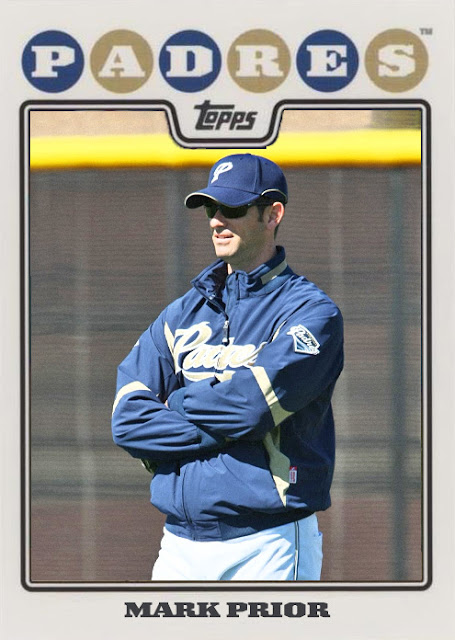
Topps Cards That Should Have Been: 2008 Mark Prior


Spring Training is finally underway, and it's the time where we get to see players working out and trying to make spots on teams, brushing off fears of injuries or age. Anyone can be a hero in Spring Training. And it's fun to see people like Robinson Chirinos, Kirby Yates, Ender Inciarte and James Paxton all trying to make it on odd teams. 

It brings me to the memory of another case of this from 2008, of a guy who at one point was one of the best pitchers in baseball. Former Cubs hero Mark Prior.

From 2002 until 2005, Mark Prior had a combined 16.6 WAR, including a huge season in 2003, with 256 Ks and a 7.4 WAR, helping his Cubs contend for a World Series [and thanks again to Steve Bartman for foiling that]. Like most true hurlers in this era, or any, Prior was felled by injuries, and by 2006 he was too injured to really succeed in Chicago, leading to an entirely dark 2007 season, and the Cubs releasing him.

The Padres, however, took a chance on Prior after recovering from more arm surgeries, and signed him to a minor league deal for the 2008 season. Upper Deck even produced a card of him, posed, as a Padre, but Topps did not. Prior looked to be a shaky but interesting bet for the Padres, already working with Jake Peavy and Greg Maddux in their rotation that year. Ultimately, the same issues that befell Prior in Chicago struck here as well, and Prior didn't make the team, or the majors again.

There's a lot of great articles out there about Prior's multiple comebacks with Pawtucket and Louisville, and how he never truly gave up even after losing the majority of his promise. I won't try to step on their toes.

This is the sort of spring training stint I think about a lot. Maybe there's a chance. Maybe not. Still good to give it a shot, warm up, see if there's anything worthy. I hope a lot of these guys in the same position Prior was in back in '08 are able to make things work this year. 

Monday, November 29, 2021

Topps Cards That Should Have Been: 2008 White Sox


People have forgotten about this due to the actual outcome of that season, but the White Sox won the division in 2008. Like, they made the playoffs, had a strong team, and had some of the strongest pitching energy of the season. Between John Danks, Javier Vazquez, Gavin Floyd, Mark Buehrle and Bobby Jenks, the pitching in Chicago was enough to make this team truly formidable.

However, because Topps is Topps, a few pieces of this team didn't make the cut in Flagship or Update, and I'm gonna go over those today.

The biggest omission is Matt Thornton, one of the more consistent relief pieces of this era of White Sox baseball. Thornton is the most utilized Sox reliever in 2008, and he had a great year, with a 2.67 ERA and 77 Ks in 67 innings, as well as the lowest WHIP on the pitching staff. It's a year that sets him up for a great career, and a 2010 ASG gig.


Scott Linebrink was known to me in 2008 for his 2007 Topps card on the Padres, which features an almost nostalgic bit of ugliness on a baseball card. Linebrink, if you'll recall, was damn near unhittable mid-decade with San Diego, and was a chief relief asset on those teams. In 2007 he's traded to Milwaukee, and in 2008 he signs with the White Sox on a 3 year deal and does well enough for himself. His first year in Chicago, he has a 3.69 ERA in 46 innings, and was his last truly great season before a career downturn.

Oh, brother, this guy again. Before moving back to LA and being mired in a potential wife-killing scandal [ALLEGEDLY], Esteban Loaiza is cut by the Dodgers in mid-2008 and signs with his old team, the Chicago White Sox, where he had his breakthrough in 2003. In three brief appearances, in relief, Loiaza had a 3.00 ERA, with 1 strikeout and 2 runs. These would be the last numbers of his career, and he'd instead try his hand at...y'know...cutting fuel lines [ALLEGEDLY]. 

And as for the spring training attempts, we have former Expos and Brewers starter Tomo Ohka, who had gone a bit downhill since his early-2000s heyday. In between stints with Toronto and Cleveland, Ohka suited up for the White Sox in Arizona to attempt to make the team, but, as discussed, the rotation was stocked, and Ohka wasn't gonna cut it. So he sat the year out.

Tomorrow we wrap up this month of should have been's with some 2005 Yankees.

Thursday, January 21, 2021

Topps Cards That Should Have Been: The Fernando Rodney Chronicles

Fernando Rodney may have been one of the most important relievers of the first 20 years of the 21st century. He may not have had the flashiest stats or the most saves, but his career spanned years and teams that people wouldn't even predict they would. 

2003 would have been the first season he could have gotten a Topps card, so I won't be sad that they didn't cause he was...just a lowly reliever for one of the worst Tigers teams of all time. He averaged a 6.04 ERA his first two seasons, over 47 appearances. He wasn't handed the ninth quite yet, and that'd take a few more years of people like Ugueth Urbina and Todd Jones closing games in Detroit, but he was beginning to be plugged in more and more.

2004 he sits out the year with an injury, which also explains why he doesn't have a card in 2005 Topps:


Rodney's 2005 season is a breakout year for him in the Tigers bullpen; In 39 games he posted 42 Ks and a 2.86 ERA, complete with 9 saves. The closing gig isn't his yet, and won't be until late 2006, but he's still trusted. 

'06 and '07, he gets Topps cards. In 2007 he doesn't close games thanks to Todd Jones, and mostly doesn't do much more than middle relief...


Which explains, I guess, why Topps didn't bother making a base card of his in 2008. Gotta admit, this move even surprised me as a young collector. I'd thought Fernando Rodney was a necessary relief inclusion, even in 2008, before he really took off. I was very confused. Rodney's 2008 was a step back in the right direction, saving 13 games even with a 4.91 ERA. 

From 2009, Topps doesn't miss a beat. They make flagship cards of him in Detroit, Anaheim, Tampa and Seattle, even in his waning Ms years. From 2012 to 2014 he saves 133 games, and it's absolutely huge, but he can't sustain the magic.


By the end of 2015, the Mariners give up on him in favor of Tom Wilhelmsen. So they deal him to the Cubs at the waiver deadline, which means Topps won't get to see the...very odd sight of Fernando Rodney as a Cub. This is incredibly odd. In 14 games in middle relief, Rodney had an 0.75 ERA and 15 Ks. Plus, he got to COMPETE for the first time in a while. He did well in early rungs of the playoffs but got beat up by the Mets in the NLCS. 


By 2016, Topps still wasn't convinced that Rodney was back, even if the end of the 2015 was at least worth a card. So they shrugged and missed out on Rodney's LAST ALL-STAR STINT. Yes, they got it in Update, but they had cards of him on the Marlins, which he showed up in for the ASG. Forgetting, of course, that his INSANE 0.31 ERA with the Padres was the thing that got Rodney there in the first place. In 28 games, Rodney had 33 Ks and 17 saves. These were the final indicators to Topps that Rodney was finally worth making cards of again. 

From 2017 to 2019, Topps would be pretty prompt with Rodney issues. D-Backs, Twins, A's...all good.


Yet the final stop on Rodney's journey, and the one that gained him that coveted World Series ring, went completely ignored by Topps. Yes, Fernando Rodney was a trusted relief option for the 2019 Nationals, pitching in 38 games with a 4.05 ERA and 35 Ks, and getting some postseason playing time as well. It was a great season to go out on, despite Rodney not officially throwing in the towel until the dust had settled on the 2020 season. I just wish Topps had produced a card of it, rather than making me finally branch out into customizing the relatively-tricky 2019 design. 

Still, Fernando Rodney had a long, prosperous career, marked by so many Topps cards that DID happen, that it should be a compliment to him that Topps missed so many times.
 

Monday, January 18, 2021

Topps Cards That Should Have Been: The Rey Ordoñez Chronicles

 Rey Ordoñez, for those unaware, was one of the core members of an infield that MLB Network once voted one of the greatest of all time. For a shining few seasons in Queens, the Mets were protected by the infield combo of John Olerud, Edgardo Alfonzo, Rey Ordoñez and Robin Ventura. In 1999, the four of them combined for 21.1 WAR, with Alfonzo, Olerud and Ventura scoring WAR over 5. Ordoñez only had a 2.8, but was no slouch, capping off his third straight gold glove and his career-high 60 RBIs in 99.

After the World Series team subsided, Ordonez and Alfonzo left in 2002. Eddie went to San Fran and had a steady gig for a few years. Ordonez bounced around, spending 2003 with Tampa, and botching a 2004 spring training audition with the Padres, picked up by Topps despite him never playing a game there. 

But, eventually, an MLB team did call upon the services of the once-strong shortstop, and the Cubs came calling in 2004, signing Ordoñez in May. In 23 games, Ordoñez hit .164 with a negative WAR, and was released after about a month of service. As he was gone before Update went to press, Rey Ordonez' time in Chicago never made it onto a Topps card.

It's not the official end of Ordoñez's story, however...


Yes, in 2007, three years after playing his last MLB game, Rey Ordonez tried to break back into the majors one last time with the Seattle Mariners, a team that would eventually start Yuniesky Betancourt at short. But Ordonez persevered, doing his best in Spring Training despite being one of the last members of the 2000 Mets team left in the majors [Benitez, Piazza, Hampton and Payton were all winding down]. The gig didn't work, and the Mariners didn't give him a major league run at things, which means Rey Ordonez wasn't even good enough for the 2007 Mariners by the end, but it's an interesting 'what if' scenario. 

Actually...hell, since we're talking about spring training attempts by former Mets infielders, I've got one more, and it's very relevant: 


Yeah, turns out Rey Ordonez wasn't the only member of that infield to try to break back in. 

In 2008, Edgardo Alfonzo, whose last game was in 2006 with Toronto, auditioned for a role with the 2008 Rangers, a low-level team that was beginning its trek back to relevance thanks to Josh Hamilton and later Elvis Andrus. He was 35, not to the level he was with the Mets, and just wanted a chance to play again, even for someone like the Rangers. Like Ordonez, Fonzie didn't get very far, and was cut before the season began, but we still have this picture of how the Rangers could have gone with things. 

Monday, January 4, 2021

Topps Cards That Should Have Been: The Rajai Davis Chronicles


Something about relievers and people who steal a ton of bases that always falls into the category of 'people Topps isn't exactly racing to make cards of'. I dunno, some things you can't help. 

Rajai Davis has a rookie with Topps in the 2003 Traded set. It's one of those 'XRC' type 'catch 'em before they start playing' things that the MLBPA told them to stop doing in 2006. And then, in 2006 and 2007, when Topps could have made a 'RC' issue for Davis, they didn't. They, uh...didn't want to. Stuff in 07 '52 or Bowman Heritage, whatever, but nothing in flagship. 

So. In 2007, Davis was coming off a mild rookie season in Pittsburgh where he only played 20 games. So in 2007, with the Pirates, he gets more playing time, and in 24 games he hits .271, with 5 stolen bases and 13 hits, which is a solid audition for an outfield that already has Nate McLouth, Jason Bay and Xavier Nady pretty locked up. 

Then, at the trade deadline, tragedy strikes- the Pirates, who have Paul Maholm, Ian Snell, Tom Gorzellany and Zach Duke all pitching relatively well...decide they need starting pitching help. So who do they decide that they need to fill the void? That's right, 2007-era Matt Morris. Matt Morris, his 7-7 record, his 4.35 ERA, and his promise of a return to his Cardinals numbers that will eternally go unfulfilled. So they trade Rajai Davis, who could potentially win an OF spot, to the Giants for Matt Morris. Morris proceeds to have a 6.10 ERA in 11 starts. Hooray.

Davis, however, blossoms in San Francisco. In 51 games, he hits .282 with 17 steals and 40 hits, gains a mentor figure in the form of Barry Bonds, plays more often, and makes a run at Bonds' OF position in 2008. It's a fantastic rookie effort, and one that does indicate a long career for Rajai Davis.

Unfortunately, the baseball gods had other ideas. After hitting .056 in the first 12 games of the 2008 season, even with 4 steals, the Giants gave up on Davis, and waived him. Not only did it put a stop to what would have been a fruitful career for Davis in SF, it also ruins Topps' effort to FINALLY produce a base card of Davis in flagship with the Giants. 

Because of this, they never actually produce a 2008 Topps card of the team that claimed him. [Something something Yamid Haad].


Which looks pretty mismanaged considering that Rajai Davis was the A's starting centerfielder in 2008. 

All the accolades are obvious. He hits pretty well for average with .260, leads the team in stolen bases with 25, gets 50 hits and is phased out once Carlos Gonzalez gets more starts. 

The rest is not only history, but well-documented by Topps- Gonzalez is traded to Colorado for Matt Holliday, centerfield is Davis', and he becomes a base-stealing mainstay for Oakland, Toronto, Detroit and Cleveland. 

In 2017, after a huge season for him in Cleveland, he returns to Oakland for a victory lap essentially and steals 26 bases despite hitting less for average. But the A's don't go anywhere in 2017, and in August, he's waived yet again, landing in a competitor's market...


Yeah, bet a lot of you don't remember that Rajai Davis played for Boston, eh? 

In a season where the Sox' outfield was clearly Betts-Bradley-Benintendi, Davis was brought in as a bench player, base-stealer and defensive sub. In 17 games he hit .250 with 3 steals. He was used as a defensive sub in the playoffs and didn't see any time at the plate...perhaps one of the reasons why they couldn't get past the Astros that year. 

In 2018 he returns to Cleveland, does okay. In 2019, he has one last year in Queens, which I'd definitely make if A.) 2019 Topps was easy to customize and B.) Topps managed to add that to the custom card maker. Someday I'll figure it out.

Sunday, November 8, 2020

Topps Cards That Should Have Been: The Mike Hessman Chronicles

This is one of those insanely niche things I've always wanted to do if I had the proper way of going about it. Now that this SHB Topps series is doing well for me, I might as well go for it. 

Mike Hessman is a name that many MLB fans may not have heard of. Maybe if you're a Braves fan who knew a lot about prospecting in the 2000s, or just an all-around stats expert. But if you're a Toledo Mud Hens fan...oh boy, you know Mike Hessman. You probably love Mike Hessman. Mike Hessman is the closest thing we have to a real life Crash Davis, a guy who flourished in the minor leagues but could never get things going in the majors. 

In 2015, Hessman retired with 433 home runs in the minor league level, which is an all-time mark for minor leaguers. Mike Hessman hit more home runs in the minor leagues than Andres Galarraga did in the major leagues. Think about that.

Hessman's story was rewarded by Topps a few times during their Pro Debut sets, but never in flagship. And so I figured I should rectify that. 

Okay, so 2003, Hessman is called up to the Braves at 25, plays 16 games, hits .286. By this point, Hessman has already hit 136 home runs in the minors. He hits 2 in the majors 2003. 

In 2004, he gets a slightly longer major league stint, backing up Adam LaRoche at 1st. In 29 games, Hessman bats .130 with another 2 home runs. Clearly, something's not working at the major league level yet. Meanwhile, he hits .287 with 19 home runs in Richmond. 


In 2005, as he is 27 and has been with the Braves for the better part of a decade, he's granted free agency. So he signs the first of many minor league deals with the Detroit Tigers. At this point, Hessman sort of knows the drill, it seems. He gets a little play in Spring Training, kibitzes with Ivan Rodriguez and Dmitri Young, then spends the rest of the season in Toledo playing for one of the most well-attended minor league clubs in the union, and hitting more homers. He only hits .214 this season, but he notches 28 home runs. 


2006 is similar, he doesn't get to the majors at all but keeps getting lots of playing time in Toledo. .165 average, 24 homers, which is a down year, but at least he gets to play. 


2007 is probably the closest thing to a career year for Mike Hessman. First of all, he has his best year for Toledo, hitting .254 with 31 homers and 101 RBIs. Then the Tigers need assistance at 1st, they call him up for 17 games and he hits 4 more homers covering for Sean Casey. This is his first major league play since 2004, and he does what he can to make the most of it. 


2008 is a similar year. Fantastic in Toledo, 34 home runs and 72 RBIs, which most 2008 Tigers would kill for, and a few games in the majors. This is one of Hessman's best MLB stints, as in 12 games he hits .296 with 5 home runs, making himself known as a decent backup first baseman. 

However, in 2008, the first baseman is not someone easy to back-up like Sean Casey. 2008 is the beginning of the Miguel Cabrera era in Detroit, meaning Hessman is going to get less and less major league playing time. 


In 2009, he's not going to get any, spending the entire season in Toledo despite once again having a decent time in Spring Training. This year for Hessman is slightly lower-key, with 23 home runs and 77 RBI for the Mud Hens. 

After this, the Tigers don't bring Hessman back for 2010, and Hessman hops around for a few years.


 The Mets are the first team to bite on Hessman, especially the season after losing their longtime first baseman, Carlos Delgado. So Hessman gets some playing time, though it's only 32 games. Hessman sadly only hits a measly .127, and only musters one final major league home run in his final MLB games. It's a sad way for him to go out, but thankfully, it's not the end of Hessman's baseball story.

After a mediocre season playing for the Orix Buffaloes in 2011, Hessman returns to minor league deals in America, playing yearlong stints in the AAA affiliates of the Astros and Reds, hitting 60 homers in those two seasons combined, before returning to the Toledo Mud Hens for his final two years, notching 34 home home runs in order to break the all-time minor league home run record in 2015. It's a huge moment for Hessman, for Toledo, and for the minors. 

So Mike Hessman may not have been a high priority for Topps all those years, but he was a high priority for me when I made this. One of the things I ask myself when I consider subjects for this set is 'are they important in even the most specific story of baseball?' That's why I'll include a botched draft pick that hung on for several years, or a former small-team closer who kept relieving games into his 30s. And that's why Hessman is here. You can't talk about minor league baseball in this era without talking about Hessman, and you can't tell Hessman's story without talking about his major league games. Even though a lot of these were spring training pictures that didn't amount to MLB seasons, they still warrant cards in my eyes, because Hessman's story is that unique, and that important, to this era of baseball.

Sunday, October 4, 2020

Topps Cards That Should Have Been: 2008 Midyear Deals


 The 2008 Trade Deadline was relatively well-documented in 2008 Updates and Highlights. The big guns received cards, like Manny Ramirez in LA, Ivan Rodriguez in New York, Ken Griffey Jr. in Chicago and, of course, Bartolo Colon in Boston. Also, some smaller deals were made into Topps cards, even questionable ones like Chris Snelling and Tadahito Iguchi landing in Philly, or Yamid Haad getting called up right before the print deadline before being called back down again. It would be the last time the Update set would be so needlessly comprehensive while also leaving out obvious choices. 

Some were just oversights because of deals made right after the print deadline, like Felipe Lopez being released by Washington only to sign with the Cardinals a week later. The veteran utility infielder would hit .335 in 43 games with the Cards, with 21 RBIs and 60 hits, becoming a trusted asset for a team that would fail to make a playoff run that year. 


Similarly, after a down year in Philadelphia, former Mariners All-Star fireballer Freddy Garcia was a midyear sign for the Detroit Tigers, a team the sportswriters expected to win the World Series but wound up in last. The signing happened, again, after the print date. And to be honest, it's not a TON to write home about. Garcia started 3 games, posted a 1-1 record, a 4.20 ERA and 12 strikeouts. Topps has given cards to Philippe Aumont in 2015 before, but I can see why they thought that wasn't worth it. 

2008 also counts as a crossroads for Garcia, sort of like Colon's 2009. After this year, the White Sox pick him back up, and Garcia becomes a trusted low-velocity trickster for the White Sox, Yankees and Orioles for the next 4 years. The 2008 season is Garcia looking at his poor 2007 and moving on, which is the best thing to do.


For me, this is the biggest omission.

Topps does give Matt Stairs a Phillies card in 2009, a commemoration of sorts, but...come on. Matt Stairs' career year with Philly is 2008, and he deserves a card for it.

Stairs began 2008 as a DH in Toronto, close to his home, and in August he's packed in a waiver deal to Philly to be used as a bench bat [you try starting a 40-year-old in the outfield]. In 16 regular season games, Stairs hits .294, with 5 RBIs and 2 home runs. Not bad at all. But then he makes the postseason roster, has that magical game-winning home run in the NLCS against the Dodgers, and is proclaimed the hero, even if he doesn't make much of an impact in the actual World Series. It's still a fantastic moment, which Stairs is still riding high on even 12 years later. 

And I wish Topps could have known it was coming in August.

Tuesday, September 15, 2020

Topps Cards That Should Have Been: The 2008 Imports


In 2008, the baseball world was struck by the introduction to our shores by an outfielder from Japan suiting up for the Cubs. While Kosuke Fukudome's entry into the MLB was a very big deal, and resulted in playoff time, an All Star nod, and lots and lots of gimmicked Topps cards, none of that treatment was given to another slightly-buzzy 2008 import.

Why? Because his rookie year wasn't as showy, he was a reliever, and he played for the Royals. 

After starting out as a feasible starting pitching option for the Chiba Lotte Marines in the late 90s, Yasuhiko Yabuta mellowed into a durable relief option for the Marines during the 2000s, with a 2.80 ERA between 2004 and 2007. So he posted to the US, the Royals bit, and used him in relief during the 2008 season. Yabuta responded with a 4.78 ERA in 31 games, and only 25 strikeouts. His 2009 numbers were even more dire, and Yabuta eventually went back to Chiba Lotte for his final 4 seasons of professional ball, where his ERA returned to sub-4 levels.

Topps never got around to posting a flagship card of Yabuta, despite including him in their gimmicked World Baseball Classic insert series in Series 2 along with Fukudome. Upper Deck produced cards of him, though.

Similarly, as Yabuta was beginning his short-lived US career in 2008, another Japanese import was finishing his attempt.


Keiichi Yabu is another Japanese hurler that should have had better US numbers, and his story is arguably even more obscure than Yabuta's. 

So, unlike Yabuta, Yabu makes his career, as a starter for the Hanshin Tigers, pitching alongside Kei Igawa and Hideki Irabu, and doing pretty damn well as well, averaging a 3.60 ERA, and notching 86 wins [and 110 losses]. In 2005, Yabu decides to make himself available for US markets, signs with the Oakland Athletics, and is used in relief, and, like Yabuta, comes up short, with a 4.50 ERA in 40 games, and 44 strikeouts. After this season, he's let go by Oakland and Colorado, and he sort of drops off, pitching in the Mexican leagues and independent leagues.

In 2008, he finally returns to the majors as a member of the San Francisco Giants, who sign him as a free agent. Yabu has a MUCH BETTER season here, with a 3.58 ERA in 60 games, and 48 strikeouts over 68 innings. The Giants re-sign Yabu for 2009, but unfortunately he doesn't make the team and bops around the independent circuit in Japan for the remainder of his career. Topps, like in 2005, doesn't bother to include Yabu.

Considering the issues that Topps would later have with Hideki Matsui and Ichiro Suzuki, I can say that the problem is less with the merits of Yabu and Yabuta in America and more with Topps being too choosy and subconsciously US-centric with who they include in sets. 

Saturday, September 12, 2020

Topps Cards That Should Have Been: 2008 Reliever Roundup

I think Topps just doesn't like relief pitching.

I get it, they have to put out a 600-card set every year, they can't recreate every team's 40-man, they still have to include leader cards and subsets and crap, and they have to make cards of all the relevant players and potential big rookies, but I always wonder how they decide which relievers to make for each set. Relief pitching is a very fickle business, and it's very hard to be consistently good in consecutive years. Topps can make cards of relievers who were good in 2007 for 2008, but half of them will end up crapping out and disappointing people and the deserving ones will get left out.

Collecting relievers who go on to have sharp runs late in their career is tough, because it's hard to track a chronology when Topps is so wishy-washy on who gets cards. So that's why this project exists, and this is likely the first installment of several where I just do a bunch of middle relievers and closers that deserved cards that year.

 Keith Foulke is up first because his return from surgeries in 2008 was a relatively big deal. Foulke was one of the best relief assets of the early 2000s, being extra-reliable for Chicago, Oakland, and especially Boston, becoming their closer for the 2004 World Series campaign, and notching 3 postseason saves with them. After the 2006 season he undergoes surgery, makes himself available, and his old team the Oakland A's re-signs him. This was a big deal in the baseball preview magazines back then [Athlon, Sporting News, etc], but Topps didn't move on it. 

Foulke's 2008 A's numbers were solid, with a 4.06 ERA in 31 appearances, but not enough to grant him career longevity past that season. I still think Topps should have bitten, though, as there were good photos available from the 2008 Spring Training China series.

The '08 A's also had another sharp relief asset on their roster..

 Santiago Casilla played for 14 years, won 3 World Series' as a charter member of the Giants' mega-teams, has a career 3.26 ERA, and for a good 10 year period was one of the most consistent relievers in the game. He's not necessarily a Hall of Famer, but he deserves more respect.

Casilla spent the first 6 years of his career with the Oakland Athletics, who used him sporadically early before plugging him in as a major relief asset in 2007, which means he SHOULD HAVE gotten a card in 2008 Topps but...I guess giving Chris Snelling a Phillies card was more important evidently. Casilla in 2008 held a 3.93 ERA in 51 appearances. Despite not getting his earned runs numbers down til he made the Giants, he was still a solid tool for Oakland in their dire period. 


A few guys here would eventually be trusted closers, making their lack of inclusion all the more baffling. Juan Carlos Oviedo, known in 2008 still as Leo Nunez [therefore I'm using the name Topps would have given him in 2008], had a breakout season for the Royals while Topps wasn't looking. He had a 2.98 ERA, 4 wins in 45 appearances, and would have been an intriguing unsung hero target for Topps. Heck, the Marlins even saw some promise in Oviedo, and traded Mike Jacobs to nab him, and for 3 years he was their closer, before injuries and the name issue would curtail the rest of his career. 


Another reliever whose ninth-inning numbers would take off in 2009, David Aardsma was still shadowing Jonathan Papelbon in 2008, and while he ended the season with a 5.55 ERA and 30 earned runs, it was still great lead-up to his 2009 season, where he'd notch 38 saves for the Mariners. 

Speaking of the 2008 Sox...

2008 was the last season for career setup man and relief specialist Mike Timlin, who won four World Series rings; two with Toronto in the 90s, and two with Boston in the 00s. If there was a Hall of Fame specifically for relief pitchers, he'd be first or second ballot [my dad disagrees]. Timlin's last season in Boston was, like Aardsma's, a bit disappointing; he'd have a 5.66 ERA in 47 appearances, only strike out 32, and end sort of with a whimper a season after a World Series. He still got a nice send-off from the Sox, and still comes around every time there's an anniversary of the 2004 or 2007 titles.

Brett Tomko, a reliever whose claim to fame, amongst other things, was being traded to Seattle for Ken Griffey Jr., had a card in 2008 Topps Update as a member of the Kansas City Royals. However, that's not where he ended the season. In mid-June, he was released by KC and signed as a free agent with the San Diego Padres, where he'd play the rest of the season, similarly out of the playoff conversation. 

Tomko's interesting because he was capable both as a starter and as a reliever, so while he was nowhere near as potent of a player as Griffey, he was still helpful in several spots for several teams in the 2000s. For instance, Tomko didn't start any games for SD in 2008, but he was used in longer relief, playing 9 innings in 6 appearances, and did fairly well for himself, with a 1.93 ERA and 9 Ks. This type of finish caused his stock to rise, and for the Yankees to sign him for the 2009 season...and promptly trade him to Oakland before they won the World Series. 

Speaking of 'always a bridesmaid, never a bride' types, Darren Oliver was most notably one of the 'two old men' on the 2011 Rangers with Arthur Rhodes, two guys over 40 getting batters out like the best of them. Oliver had the more scattershot career, as he bopped around for 20 years, mostly on western teams but occasionally teams like Boston or St. Louis. 2008 was in the midst of his 3 year stint in Anaheim, where he became a loyal, sturdy set-up tight to Francisco Rodriguez. Oliver, at 37, finished 2008 with a 2.88 ERA, 7 wins and 48 Ks in 54 appearances. In 2 years, he'd return to Arlington and become a World Series contender for two seasons.


Moving to a 2008-era World Series also-ran, J.P. Howell is one of the more under the radar relief heroes of the late 2000s and early 2010s, mostly with Tampa but eventually with LA. Howell's breakout season was as a member of the 2008 Rays, which is a pretty lucky time to break out. Howell's 92 strikeouts and 2.22 ERA caught the eye of a lot of people that year, and made him one of the Rays' secret weapons during the postseason, where he had another 17 strikeouts in 9 appearances, despite giving up a few more runs. He even ended up with 2 losses against the Phils in the World Series. Still, Howell rebounded and became a bullpen mainstay for this era of Rays baseball. 


As Taiwan was already beaming over the US success of Chien-Ming Wang, a second Taiwanese crossover hit was slowly booming in Los Angeles. Like Wang, Kuo showed up in the mid-2000s, and while it took him longer than Wang to find a true niche in LA, in 2008 he was finally shifted to the bullpen full-time, where he had his lowest ERA with 2.14, 96 strikeouts in 42 appearances [80 innings, though, so he was used in longer relief]. His 2008 numbers would later be dwarfed by his stellar start in 2010, where he'd be rewarded with an ASG nomination, deservingly so. 

The biggest omission for me, as far as relievers go in 2008, was Ryan Madson. When I think of the Phillies' 2008 World Series win, and that bullpen, one of the main figures I think of besides Brad Lidge is Ryan Madson, and his relief work in this era of Phillies baseball is vastly overlooked. Madson, who'd been relieving games for Philly since 2004, was already a modest bullpen threat by this point, but in 2008 he took off, with 76 appearances, a 3.05 ERA and 67 strikeouts. His postseason numbers solidified the dominance, with a 3.58 ERA, a win in the NLCS against LA, 14 strikeouts and a sub-1 WHIP. Madson would continue to be a relief highlight for Philly, Oakland, Washington and LA. Wouldn't have happened without 08. So, thanks Topps for leaving him out there.

So, those are the relievers that don't fit into other categories I have prepared for future 2008 posts, but fit here. Topps may not like relief pitchers, but I sure do.

Sunday, September 6, 2020

Topps Cards That Should Have Been: 2008 Pablo Sandoval

I swear, I was genuinely giving Topps the benefit of the doubt. I just spent 10 years assuming that out of all the numerous packs of 2008 Topps Update I bought, Pablo Sandoval's 2008 Topps rookie card wasn't in it. It happened with Max Scherzer's rookie card, and I'm still looking for that. So I just assumed it was out there and I didn't have it.

 To give you an idea, a few years ago I run into Sandoval's 2006 Bowman rookie card for 10 cents. How that didn't confirm it for me, I have no idea.

But anyway. Other than the Red Hot Rookie release for hobby shops, Pablo Sandoval doesn't have an official Topps rookie card in 2008, and his 2009 Topps release is technically his flagship debut. Which is why I made one for this series, because he's Pablo frigging Sandoval and he deserves one.

His 2008 numbers, for the record, were really good. In 41 games he hit .345 with 24 RBIs, and finished the season with the 6th-highest WAR in San Francisco, higher than Aaron Rowand, Ray Durham, Jonathan Sanchez, and actual All Star that year Brian Wilson. That he would later go onto lead this team to a few World Series' may not have been immediately evident, but it made sense.

As alarming as it is that I figured I was done making 2008 ones for this project and last post gave me an idea for another one....this post gave me an idea for another one still. Two more, actually. 

Saturday, September 5, 2020

Topps Cards That Should Have Been: The 2008 Rookies


...well, since blogger took away the ability to caption photos...I guess I've gotta do away with the obvious.

2008 Topps is a weird year in terms of their rookie selection, because there is personnel that appears in Upper Deck sets, premium sets, and even their hobby-exclusive Red Hot Rookie program, and yet still fails to receive a card in actual flagship. 

Alexei Ramirez is one of the biggest rookie stories of 2008, bursting onto the scene in Chicago as a compact little shortstop with a 2.5 WAR, and notching 77 RBIs and 21 home runs, both admittedly career highs, while also coming in second during Rookie of the Year voting. Topps does not give him a rookie card in Update. What they DO give him is a World Baseball Classic short-printed gimmick hidden in the set along with Yasuhiko Yabuta and the set's rookie giant Kosuke Fukudome. All three players were supposed to have regular cards in the flagship set, but were reduced to gimmicks. 

Only Fukudome got an actual Update Series base card. Ramirez did get a card in Update, but it was a World Baseball Classic insert. Meanwhile, Upper Deck was producing base rookies of him like it's nothing. It was a maddening affair that robbed a genuinely good player of an official rookie card.


Not every rookie I made for this project comes off like Ramirez'. Daniel Murphy got an official Topps rookie in 2009's flagship set, but he still appeared in 49 games in 2008, hitting .313 with 17 RBIs in 49 games, which isn't bad at all. Sadly, a lot of this production came after the cutoff, so his chance at a 2008 Topps rookie card dissipated. 

But this one looks nice. The black Mets uniforms were underrated. And it's odd to see someone affiliated with mid-2010s Mets success wearing one. Kinda like how odd it is to see Jose Altuve in 2011-era Astros uniforms. 


We go slightly more obscure for this next rookie.

Ernesto Frieri is best known for his role as the fun-loving Angels closer in 2013, and his eventual trade to Pittsburgh in 2014 for Jason Grilli. Before landing in LA, Frieri was a staple for the Padres' bullpen, and while he didn't debut until 2009, a Spring Training photo does exist from the 2008 season, and by the rules of this project, that totally counts. Topps has based rookie cards on far less. 

So Frieri gets a rookie card in 2008. Because why not?


Similarly present in 2008 Spring Training but absent for most of the actual season was future A's DH and power-hitter Brandon Moss. Moss was among the squad that played overseas for a few games in Spring 2008, as he was being primed for an infield position that would eventually go to Jed Lowrie. 

The reason he doesn't have a 2008 rookie card with Boston, apart from Topps being harebrained and not giving him one after his 2007 debut campaign, is that after 34 games in Boston, Moss was traded to Pittsburgh for Jason Bay. Bay would be an outfield asset and All-Star for Boston, while Moss would continue his utility man role in Pittsburgh, where he would get his 2008 Update rookie card. 


Ian Kennedy has a rookie card with Upper Deck in 2008. As a matter of fact, he's all over Upper Deck's third quarter releases. Perhaps Kennedy was sought as the 'token Yankee rookie' that year, despite not getting a ton of playing time.

Despite his solid 2007 numbers, Kennedy would have an 8.39 ERA in 2008, and eventually be eased out of starting, and the majors. Topps wouldn't produce a card of him in 2009 either, and his 2010 Topps release would technically be his Topps rookie card. By 2010, Kennedy had already been traded to Arizona in the Curtis Granderson deal [but really we should be calling it the Max Scherzer deal at this point], and his career was already burgeoning as an ace in Phoenix.

Unrelated, but I bet Upper Deck would have rendered this entire project meaningless if they'd kept their license after 2009. 


Which leads us back to the 2008 Red Hot Rookie series, one of the charter members of which was Jeff Samardzija, a Cubs reliever with a funky windup and a funkier name. 

Unlike Kennedy, Samardzija's inclusion in this set does not mean he didn't receive any Topps releases in 2008. Topps liked him a lot during the last quarters of 2008, and included him in Finest and Heritage High Number. Yet he did not get a card in Update Series, and would have to wait until 2009 Topps to get an official rookie card [now that I am realizing this, neither did Pablo Sandoval, whom I always assumed has a 2008 Update card I just never pulled. So I guess I have to make one of him now].

Shark's 2008 number certainly would have warranted a rookie card, though. With a 2.28 ERA and 25 strikeouts in 27.2 innings, he was clearly one of the brighter relief options of the competitive 2008 Cubs team. It just stinks that Topps' silly quotas prevented them from actually making a rookie card of him that year.


Those are the 6 newest additions to the Should Have Been series. Now I, admittedly, have to go make a Pablo Sandoval one.

Thursday, September 3, 2020

Topps Cards That Should Have Been: The Nomar Chronicles

Topps SHB #12: 2008 Nomar Garciaparra, Los Angeles Dodgers
 Topps' contractual meddling will never cease to annoy me.

Takes them an extra 4 years to rope Alex Rodriguez in. Takes an extra 2 years to rope Hideki Matsui in. Then in 2006, we lose Nomar Garciaparra, they don't re-up with him til after he's retired. In 2009, Matt Wieters signs with Upper Deck and Panini, but not Topps, and they eventually get him in 2016. So now they have everybody, right? Well in 2018 they lose Madison Bumgarner, and now only Panini makes cards of him. However Topps keeps screwing this up, they're clearly good at it.

Because of this meddling, former Boston great Nomar Garciaparra's Topps legacy ends in 2006, with his Update card with the Los Angeles Dodgers. His career goes on for three more years, even if Topps doesn't seem to care.

My photo source only goes back as far as 2007, so for the purpose of this project, we start in 2008. Nomar Garciaparra is a charter member of the division-leading, NLCS contending 2008 Dodgers. Nowadays, that sort of thing would be depicted on a card, but Topps was led by Michael Eisner at the time, which should explain everything.

Nomar's 2008 season was marred by injuries from the start, but eventually he became a starting shortstop due to an injury to Rafael Furcal, and started heating up along with the team in August. He hit .264 in only 55 games in 2008, but was still a crucial member of the team, and a notable bench player in the postseason, hitting .429 in 7 at-bats.

Topps SHB #13: 2009 Nomar Garciaparra, Oakland Athletics
Nomar's 2009 season with the A's was an improvement on several levels, as he hit .284 in 65 games, and returned to his contact sensibilities with a very low-budget team. Again, he was used as a bench player, and slowly phased out in favor of players like Daric Barton and Jack Cust, but he was still a trusted veteran presence on a team that was very youth-based. It may not have been an ideal final season for Nomar, but he ended with dignity and respect, which is all that a Red Sox alum should ever want.

After that, Nomar hung up his cleats and switched to broadcasting, and has appeared in numerous Topps sets as a Red Sock. I doubt Topps will ever acknowledge Nomar's stints in LA or Oakland, or even Chicago, but I guess that's why I do this- to cover for Topps when they have these blind spots like this.

This reminds me...I have a ton of Matt Wieters cards to make for this project, don't I?

Tuesday, September 1, 2020

Topps Cards That Should Have Been: 2008 Nelson Cruz & J.A. Happ

Topps SHB #10: 2008 Nelson Cruz, Texas Rangers
Nelson Cruz doesn't have a Topps card from 2008.

Boggles the mind.

These early-era omissions by Topps are a lot more striking when the player actually has an excellent career. Nelson Cruz had a very okay 2007, hitting .235 in a bench role, and Topps, who'd made a card of him there, decided not to re-up in 2008. In 2008, in 31 games he hit .330 with 7 homers and 26 RBIs, setting the stage perfectly for his breakout year in 2009. But, because said 2008 numbers came later in the season, Topps didn't have time or room for him.

A shame, because it's a gap in a career that would soon become monolithic and HOF-caliber. Cruz is now 40 and hitting .311 with a league-leading 13 homers. It'll be interesting to see what the voting committee thinks of him, especially considering most of his production came after the age of 28.

Despite the lack of image choices, this custom was a simple one thanks to Spring Training photos. This next one was a lot simpler:

Topps SHB #11:2008 J.A. Happ, Philadelphia Phillies
J.A. Happ, similar to Nelson Cruz, had a 2007 card, his Update rookie card in fact, and sat out the 2008 flagship season for some reason before coming back in 2009 Topps. The reason J.A. Happ is in 2009 Topps but not 2008 Update is because the majority of Happ's 2008 numbers came after the cutoff date. Happ was an arm uitilized mostly in September and October for the Phils, which is honestly a good problem to have.

Happ had a 3.69 ERA in 8 games, 4 of them starts, so he was slowly being phased into the rotation as the Phillies got closer to the postseason. Happ made 3 innings of appearances during the NLCS against the Dodgers, did fairly well, and sat out the World Series. It's still a 2008 season that deserves some sort of commemoration from Topps, but...a bit too late, I guess.

Of course, after that 2008 season, Happ became one of the more trusted starters in the game in several points, for Houston, Toronto, and now, in good days, New York.

Cruz and Happ are still some of the best veterans in the game, which makes it odd when Topps misses a step in their careers.